


TL;DR
Dreamcast Cashless and Tappit both provide RFID-based cashless payment solutions, offline transaction capabilities, reporting, and access-control features, but their strengths differ.
Dreamcast is a strong option for organizers looking for event-focused payment operations alongside inventory, billing, top-ups, refunds, and broader event technology. Tappit stands out for its focus on customer data, mobile wallets, loyalty, personalization, and integrations. The better choice depends on whether your priority is streamlined event operations or a broader payment-and-data ecosystem.
Going cashless at an event sounds simple because it can give attendees a way to pay without carrying physical cash and let them tap to purchase food, drinks, merchandise, or other experiences.
But once you are actually planning a large event, you quickly realize there is much more to consider.
How will attendees top up their balance? What happens if the internet goes down? Can the same credential be used for access control? How quickly can vendors process payments? What data will organizers receive? Can the system work with your existing event technology?
That’s why choosing a cashless event platform should not come down to simply asking which provider offers RFID wristbands.
In this blog, we will compare Dreamcast Cashless vs Tappit across the areas that matter most to event organizers, so you can decide which approach fits your event better.
Overview of Dreamcast Cashless & Tappit
Both Dreamcast and Tappit offer cashless payment technology designed for events and venues. Both support RFID-based payments, offline functionality, data and analytics, and integrations with wider event operations.
| Feature | Dreamcast Cashless | Tappit |
| RFID cashless payments | ✓ | ✓ |
| NFC payments | ✓ | ✓ |
| RFID cards/wristbands | ✓ | ✓ |
| Offline payments | ✓ | ✓ |
| Mobile payment options | ✓ | ✓ |
| Real-time transaction data | ✓ | ✓ |
| Top-ups | ✓ | ✓ |
| Refunds | ✓ | ✓ |
| Inventory management | ✓ | — |
| Tax invoice billing | ✓ | — |
| WhatsApp-based reports | ✓ | — |
| Access control | ✓ | ✓ |
| Zone management | ✓ | ✓ |
| Loyalty/engagement | — | ✓ |
| White-label mobile wallet | — | ✓ |
| Event ecosystem beyond payments | ✓ | Payment/data ecosystem |
| Primary strength | Event-focused cashless operations | Cashless payments + data ecosystem |
The important thing to notice is that there is considerable overlap. The difference becomes clearer when you look at how each platform approaches the wider cashless ecosystem.
What Is Dreamcast Cashless?
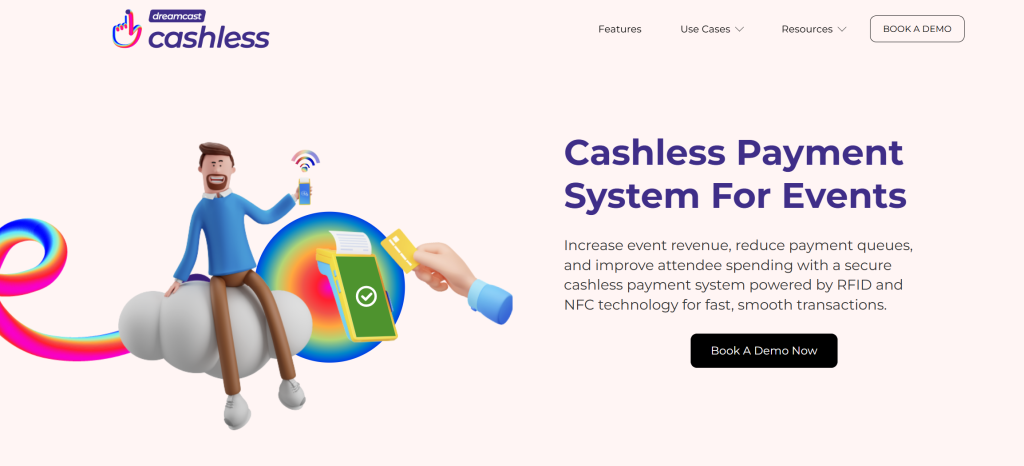
Dreamcast Cashless is an event payment solution built around RFID, NFC, and digital payment technology.
The basic workflow is straightforward: attendees receive an RFID- or NFC-enabled card or wristband, add funds, and then tap their credential at participating payment points. Organizers can monitor transactions and access sales information through the platform.
But Dreamcast positions its cashless solution as more than just a payment tool.
RFID and NFC-Based Payments
Attendees can use RFID- or NFC-enabled cards and wristbands to make contactless payments at event outlets.
This can be particularly useful for festivals, conferences, exhibitions, and other large events where speed at food, beverage, and merchandise counters matters.
Offline Payment Capability
One of the important considerations for event organizers is connectivity.
Dreamcast’s cashless system supports transactions even without continuous internet access, allowing payments to continue when connectivity is unreliable.
That can be useful for outdoor festivals, large venues, temporary event sites, or locations where network congestion is a concern.
Top-Ups and Refunds
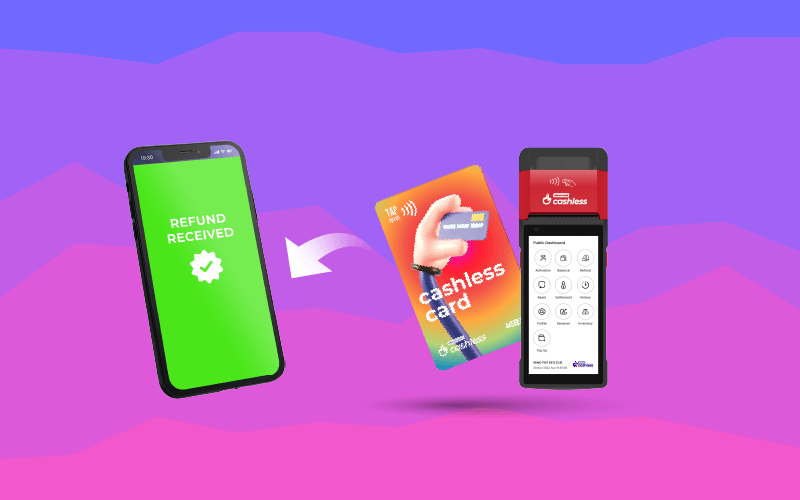
Attendees can add money to their cashless balance, while the system can support refunds after the event depending on the organizer’s refund policy.
Dreamcast also provides recharge-from-anywhere functionality, which can help reduce queues at physical top-up counters.
Inventory and Billing
Dreamcast goes beyond payment processing with features such as inventory management and tax invoice billing.
For organizers managing food, beverage, or merchandise vendors, this can help connect transactions with stock and billing operations.
Reporting and Real-Time Insights
Organizers can access transaction and sales data to understand attendee spending patterns and event performance.
Dreamcast also promotes WhatsApp-based reporting, allowing event teams to receive automated reports and monitor key information.
So, if you want a cashless system that connects closely with broader event operations, Dreamcast takes that approach.
Also Read: How to Manage Event Payments for 50,000+ Event Attendees Using Cashless Technology?
What Is Tappit?
Tappit describes itself as a payment and data ecosystem for events, attractions, stadiums, and venues.
Its offering includes cashless RFID, mobile payments, white-label mobile wallets, event analytics, access management, and loyalty capabilities.
That makes its positioning slightly different.
RFID Cashless Payments
Tappit’s RFID solution allows attendees to preload credit onto an RFID wristband or card and then tap it to pay.
The system is designed to work offline, making it suitable for environments where reliable Wi-Fi or mobile connectivity is not guaranteed.
Mobile Pay and Digital Wallets
Tappit also offers mobile payment options.
Its white-label mobile wallet can be integrated with an existing event app, while an app-free browser-based wallet can also be used. This gives organizers an option beyond physical RFID credentials.
Tappit Insights
Data is a major part of Tappit’s proposition.
Its Tappit Insights platform can bring together information from different systems, including ticketing, purchases, parking, and loyalty programmes, to create a broader view of customer behaviour. Reporting is available in real time.
Access and Zone Management
Tappit also supports access and zone management, allowing organizers to control access to areas such as VIP sections and backstage zones.
This means the same RFID ecosystem can play a role in both payments and access control.
Dreamcast Cashless v/s Tappit: Feature Comparison
Now, before you decide based on just description you need to know both platform through and through. Here is a detailed feature comparison:
1. Payment Experience
At the basic payment level, both platforms follow a similar model.
Attendees use an RFID credential or another supported payment method, and vendors process transactions through compatible payment hardware.
Dreamcast emphasizes fast RFID/NFC payments, offline capability, top-ups, and payment management, while Tappit combines RFID with mobile payment and wallet options.
Which Is Better?
It’s a tie for core cashless payments.
Your decision should depend more on the rest of your event ecosystem than on whether either platform can process a tap payment.
2. Offline Capability
For festivals and large outdoor events, connectivity can become a serious operational concern.
Both platforms address this by supporting offline cashless payments.
Dreamcast states that its system can process transactions without continuous internet access.
Tappit similarly states that its RFID solution works offline and is designed for environments where Wi-Fi can be unreliable.
Which Is Better?
Tie.
If offline operation is one of your most important requirements, both are worth considering. During vendor evaluation, however, ask specifically about offline transaction limits, synchronization, reconciliation, device battery life, and what happens when connectivity returns.
3. Data and Analytics
This is where the comparison gets more interesting.
Dreamcast provides real-time transaction reports and insights into attendee spending, with features such as WhatsApp-based reporting and real-time statistics.
Tappit puts customer data and analytics at the centre of its offering through Tappit Insights. The platform can combine information from different systems to provide a broader customer view.
Tappit also emphasizes using spending behaviour to create targeted offers, rewards, and loyalty experiences.
Which Is Better?
Tappit has an edge if deep customer data and loyalty capabilities are your priority.
Dreamcast is attractive if you want transaction reporting closely connected to broader event operations.
The better option ultimately depends on which data you need and how you intend to use it.
4. Access Control and Event Operations
Cashless technology does not have to stop at payments.
An RFID credential can potentially become part of a wider event-access ecosystem.
Dreamcast supports access-control use cases, including tracking guest movement, managing restricted areas, monitoring room capacity, and session tracking.
Tappit also offers zone management, including controlling access to areas such as VIP and backstage zones.
Which Is Better?
Tie for core access-control requirements.
If your event requires sophisticated access rules, ask both providers to demonstrate exactly how payment credentials connect with entry systems, zones, permissions, and real-time monitoring.
5. Loyalty and Attendee Engagement
This is one area where Tappit’s offering stands out.
Tappit supports loyalty programmes, rewards, targeted incentives, and personalised offers based on customer behaviour.
For example, an organizer could use spending behaviour to create targeted promotions or encourage specific attendee actions.
Dreamcast’s cashless solution focuses more heavily on payment operations, reporting, inventory, billing, top-ups, and event management.
Which Is Better?
Tappit if loyalty, targeted rewards, and customer engagement are central to your cashless strategy.
6. Integrations
Your cashless system should not operate in isolation.
You may already have ticketing software, POS systems, CRM, event apps, access-control systems, loyalty platforms, payment providers, and registration technology.
Tappit describes its platform as technology-agnostic and says it can integrate with existing ticketing, POS, CRM, payment, and loyalty providers.
Dreamcast also positions its cashless technology as part of its wider event-tech ecosystem, alongside registration, ticketing, access control, and other event solutions.
Which Is Better?
Neither should automatically win here.
Choose the platform that integrates more cleanly with the technology you already use.
Ask for a technical integration plan before signing a contract rather than relying only on a feature list.
Also Read: Cashless Payment Statistics That Reveal the Future of Event Transactions
What Should You Ask Before Choosing a Cashless Platform?
Before making the final decision, don’t stop at the demo. Ask both providers:
How does offline mode work?
Find out how transactions are stored, synchronized, and reconciled after connectivity returns.
How are refunds handled?
Understand the refund window, process, fees, and responsibility between the organizer, vendor, and platform.
What happens if a wristband is lost?
Ask how balances are protected and whether credentials can be blocked or replaced.
What data will we actually receive?
Don’t settle for “real-time analytics.” Ask for sample dashboards and reports.
What integrations are supported?
Share your existing ticketing, POS, CRM, app, and access-control stack.
What happens during a major event-day failure?
Ask about hardware replacement, technical support, backup connectivity, battery management, and onsite support.
These questions will tell you far more than a generic feature comparison.
Final Verdict: Dreamcast Cashless or Tappit?
There is not a universal winner.
Dreamcast Cashless makes a strong case if you want an event-focused cashless solution that combines RFID/NFC payments with operational features such as inventory management, billing, top-ups, refunds, access control, and real-time reporting, just like it did for JLF 2025. You can read more about it here:
JLF 2025: How Dreamcast Powered Access, Networking & Payments with One Smart Badge
Tappit is particularly compelling if your strategy goes beyond payment processing and puts greater emphasis on customer data, mobile wallets, loyalty, personalised engagement, access management, and integration across an existing technology ecosystem.
So, do not ask only:
“Which cashless platform is better?”
Ask:
“What do I need my cashless platform to accomplish beyond processing payments?”
If your priority is streamlined event payment operations and broader event-tech capabilities, Dreamcast Cashless may be the better fit. If your priority is building a deeper payment-and-data ecosystem around customer behaviour, loyalty, and engagement, Tappit may be worth a closer look.
The right choice is ultimately the one that fits your event size, payment model, connectivity, existing technology, attendee experience goals, reporting requirements, and budget.
FAQ’s
Both can support large-scale cashless operations. Dreamcast is well suited to event payment operations and broader event technology, while Tappit places strong emphasis on payments, customer data, loyalty, and integrations.
Yes. Both platforms support offline cashless transactions, which can be useful at festivals and other events where internet connectivity may be unreliable. Organizers should confirm each platform’s offline limits and synchronization process.
Yes. Both platforms support RFID-enabled credentials for contactless event payments. Depending on the setup, these credentials can also be connected with access control or other event functions.
It depends on what you want to measure. Dreamcast focuses on transaction and operational reporting, while Tappit places greater emphasis on combining payment data with customer behaviour, loyalty, and information from other systems.
Yes. Both platforms can extend RFID technology beyond payments to support access and zone management. This can help you manage areas such as VIP sections, restricted zones, or backstage spaces.
Compare them based on your event size, payment requirements, offline capabilities, integrations, reporting needs, access control, attendee engagement, and refund process. Choose the platform that fits your existing event ecosystem rather than simply choosing based on the number of features.