

TL;DR
Cashless payment systems for exhibitions replace bills and coins with UPI, cards, wallets, and RFID or NFC wristbands. Lines get shorter, booth transactions get faster, and organizers get clean, real-time sales data instead of handwritten registers.
- Visitors enjoy a smoother day with no cash to carry.
- Exhibitors close more sales at every booth.
- Organizers cut cash-handling risk and reconciliation headaches.
- Bottom line: if you are planning a trade show, expo or consumer fair, going cashless is no longer a nice-to-have. It is the quickest way to raise both satisfaction and revenue on the show floor.
Why Every Modern Exhibition Is Moving Cashless
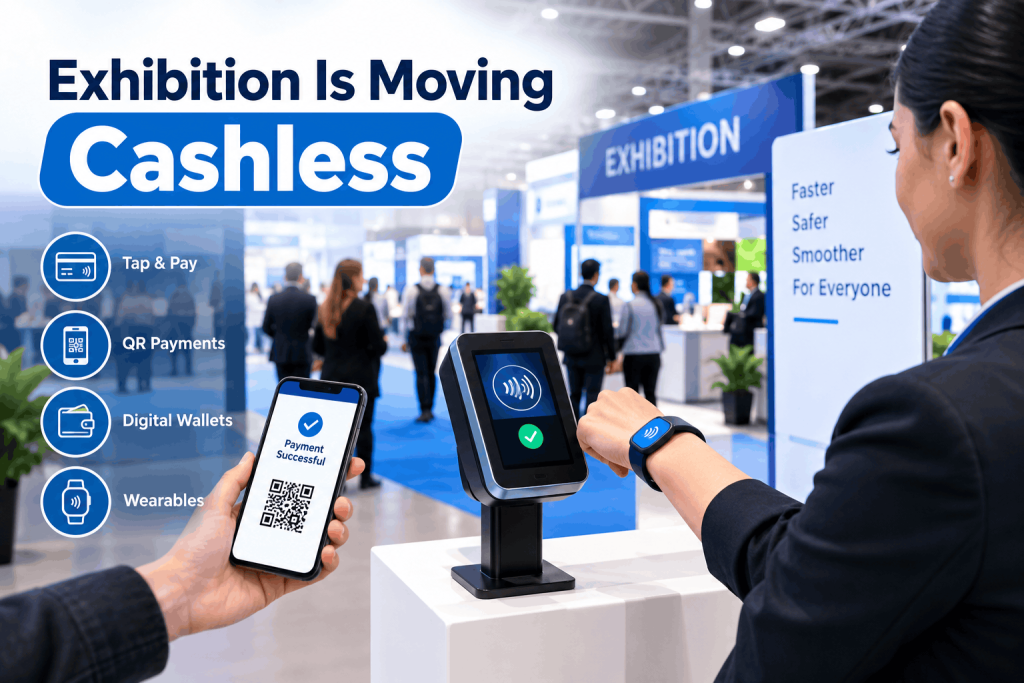
Visitors expect the same ease at an exhibition that they get everywhere else: a quick tap, a smooth checkout, and no hunting for change. Cash slows all of that down. It frustrates attendees, costs exhibitors sales, and leaves organizers with little visibility into what is happening on the show floor.
India’s payment habits have changed rapidly. UPI has made QR-based payments second nature for millions of people, and tap-to-pay cards and wallets are now familiar even to first-time users. Visitors arrive at exhibitions expecting to pay the same way they pay at their neighborhood store: instantly, from their phone.
The scale of that shift is clear in the data. UPI processed 24.07 billion transactions worth Rs 29.37 lakh crore in September 2026, with volume up 23% year-over-year and value up 18%.
That is why cashless for exhibitions has moved from experiment to expectation. Organizers who adopt it see shorter lines, happier exhibitors, and far better visibility into what is selling. Those who stay cash-only quietly lose revenue to friction. This guide explains how cashless payment systems for exhibitions work, which payment methods to offer, what benefits to expect, and how to choose the right partner.
Understanding Cashless Payment Systems in an Exhibition Setting
A cashless payment system is a setup that lets visitors pay for goods and services at an event without handling physical currency. In an exhibition context, that usually means a connected ecosystem rather than a single card machine: payment acceptance at every booth, food counter, and service desk, linked to a central dashboard that records every transaction.
There are two broad models:
- Direct payments. Visitors pay at each booth using their own UPI app, debit or credit card, or digital wallet. The system simply ensures that every exhibitor can reliably accept these methods.
- Pre-loaded (closed-loop) payments. Visitors load money onto an RFID or NFC wristband, card, or app balance, either online before the event or at a top-up point on-site. They then tap to pay anywhere inside the venue.
Many exhibitions combine both. Direct payments suit high-value purchases and B2B deals, while pre-loaded wristbands suit high-footfall consumer expos where speed matters most.
Behind the Scenes: How Cashless for Exhibitions Works Step by Step
The technology can sound complicated, but the visitor journey is deliberately simple.
- Registration and setup. The organizer configures the system, sets up exhibitor accounts, and decides which payment methods will be accepted. Visitors can register online and link a payment method or pre-load a balance.
- Entry and activation. At the gate, visitors receive a badge, wristband or QR pass. Their entry ticket and payment identity can be combined into one item, so there is nothing extra to carry.
- Tap, scan, or swipe at the booth. Exhibitors use a point-of-sale device, a smartphone app, or a QR code. The visitor taps the wristband, scans the code or presents their card, and the payment is confirmed within seconds.
- Real-time recording. Each transaction is logged instantly on a central dashboard, showing which booths and products are performing and at what time of day.
- Top-ups and refunds. If a visitor runs low, they can top up at a kiosk or through an app. Any unused balance can be refunded after the event, depending on your policy.
- Settlement. After the show, the platform reconciles all sales and settles exhibitor payouts, producing reports that are easy to audit.
Because every step is digital, there is no manual counting, no handwritten receipts, and far less room for error.
The speed gain at the booth is easy to see in numbers. A Live Nation project manager said an average cash transaction takes roughly 50 seconds, against about 15 seconds for a cashless one.
Payment Options Exhibitors and Organizers Can Offer
The best cashless exhibition setups give visitors choice. Here are the main options to consider.
- UPI and QR codes. The most widely used payment method. A static or dynamic QR code at each booth lets visitors pay in a few taps. It is cheap to deploy and needs no special hardware.
- Debit and credit cards. Card machines remain essential for higher-value purchases and for international visitors. Contactless tap-to-pay makes them considerably faster than chip-and-PIN.
- RFID and NFC wristbands. Visitors load funds and tap a wristband at any booth. This is the fastest method on the floor because there is no phone to unlock and no PIN to enter. It also works well in crowded or low-connectivity areas, since many systems can process payments offline and sync later.
To see how tap-to-pay wristbands speed up checkout, read Dreamcast’s guide to quick checkout wristbands.
- Mobile wallets and event apps. Branded event apps can combine tickets, maps, exhibitor lists and payments in one place. Wallet payments also let you run loyalty points or promotional credits.
- Payment links and online invoices. For B2B exhibitions, exhibitors can send a payment link after a demo, which is useful for bookings, deposits and larger orders closed on the spot.
Offering two or three of these together usually covers every kind of visitor without overcomplicating the experience.
Why Cashless Wins: Benefits for Visitors, Exhibitors and Organizers
The headline benefit of cashless payment systems for exhibitions is speed, but the advantages go much deeper. Here is how each group gains.
Better Experience for Visitors
- Shorter lines. A tap or a scan takes seconds, compared with the counting and change-giving of a cash transaction. Visitors spend more time exploring and less time waiting.
- Nothing to carry. No wallets stuffed with notes, no hunting for exact change, no trips to an ATM that might be empty or far away.
- Safer and more comfortable. Fewer people carrying cash means lower risk of theft and a more relaxed atmosphere.
- Easier spending. When paying feels effortless, visitors are more willing to try a sample, grab a snack, or buy that product they were unsure about.
- Transparent balances. With wristbands or apps, visitors can see what they have spent and what remains, and can claim refunds on unused credit.
Higher Sales for Exhibitors
- More transactions per hour. Faster checkout means a booth can serve more customers during peak footfall. This matters most at food stands, retail counters and demo-heavy stands.
- Fewer abandoned purchases. Visitors who have no cash on hand no longer walk away. If they can pay by UPI or card, the sale happens in the moment.
- Bigger basket sizes. People tend to spend more when they are not parting with physical money. Add-ons and upsells become easier.
- Less cash-handling stress. Staff no longer need to count, make change, or worry about counterfeit bills, so they can focus on selling and talking to customers.
- Instant sales visibility. Exhibitors can see sales as they happen, spot slow hours, and adjust pricing, staffing, or promotions during the event.
Real-world results back this up. According to Access AA, Jika Jika Festival in Northern Ireland saw spending per person rise 23% compared with non-cashless events at the same location the previous year.
Control and Insight for Organizers
- Real-time data. A live dashboard shows total spend, peak hours, popular booths and footfall patterns. These insights help with layout planning, sponsorship pricing, and future events.
- Reduced fraud and leakage. Digital records make it much harder for money to go missing, and there is a clear audit trail for every rupee.
- Simpler reconciliation. Instead of days of counting and matching paper receipts, settlement is largely automatic.
- Lower operating costs. Less cash means fewer security needs, fewer staff on counting duty, and fewer errors to resolve.
- New revenue opportunities. Sponsored top-up points, branded wristbands and promotional offers create fresh income streams.
- Sustainability. Digital payments and e-receipts cut down on paper use, which supports your green event goals.
Cash vs Cashless at the Show Floor: A Side-by-Side Look
If you are still weighing the decision, a direct comparison helps.
| Factor | Cash Payments | Cashless Payments |
| Transaction speed | Slow, due to counting and change | Fast, usually a few seconds |
| Line length | Long during peak hours | Noticeably shorter |
| Security | Higher risk of theft and counterfeit bills | Lower risk, with encrypted digital records |
| Sales tracking | Manual and delayed | Real-time and automatic |
| Reconciliation | Time-consuming and error-prone | Automated reports |
| Staff effort | Cash counting, change management | Minimal, more time to sell |
| Visitor convenience | Needs ATM visits and exact change | Pay from phone, card or wristband |
| Data for future planning | Little to none | Detailed spending and footfall insights |
| Fraud risk | Higher | Lower, with a clear audit trail |
Cash still has a place for visitors who prefer it, but as the main payment method on the floor, it creates friction that cashless eliminates.
Choosing the Right Cashless Platform: A Buyer’s Checklist
Not every provider is equal. Before you sign, check the following.
- Reliability under pressure. Exhibitions generate sudden bursts of traffic. Ask about uptime, performance during peak hours, and what happens when the internet drops. Offline payment capability is a major advantage in large venues.
- Range of payment methods. The platform should support UPI, cards, wallets, and wristbands so you are not forcing visitors into a single option.
- Speed and ease of use. Booth staff are not technicians. The point-of-sale interface should be simple enough to learn in minutes, with minimal training.
- Real-time reporting. Look for dashboards that show sales by booth, by hour, and by product, with exportable reports for finance teams.
- Smooth top-up and refund process. Visitors should be able to load money easily online or on site, and request refunds without hassle.
- Security and compliance. The provider should follow recognized payment-security standards and protect personal and financial data.
For a closer look at fraud risks, access controls and dispute handling, read Dreamcast’s guide to anti-fraud cashless payment systems for events.
- Integration with ticketing and registration. The best experience comes when entry, identity, and payment live in one connected system.
- On-site support. Hardware failures and questions happen. A provider that places trained staff at your venue can resolve issues before visitors notice.
- Transparent pricing. Understand setup fees, hardware rental, transaction charges, and settlement timelines upfront so there are no surprises.
Dreamcast: Taking Your Exhibition Cashless
Setting up a cashless ecosystem involves hardware, software, staffing, and planning, and that is where an experienced partner makes a real difference. Dreamcast supports exhibition organizers in bringing the whole experience together, from visitor registration and entry to on-site payments and post-event reporting.
With Dreamcast, organizers can plan a cashless setup that fits the size and style of their show, whether it is a compact B2B expo or a large, high-footfall consumer exhibition. The focus is on making the visitor journey smooth, giving exhibitors a reliable way to accept payments and giving organizers the data they need to measure success and improve every edition.
If you are considering cashless payment systems for your next exhibition, speak to the Dreamcast team about your venue, your expected footfall and your goals. A short planning conversation early on can save a lot of last-minute stress and set your event up for a faster, smarter and more profitable show.
Final Thoughts
Exhibitions succeed when visitors feel comfortable, exhibitors make sales, and organizers can prove value to sponsors and stakeholders. Cashless for exhibitions supports all three goals at once. It shortens lines, removes the awkwardness of cash, speeds up booth transactions, and turns every payment into usable data.
The shift is already happening. Visitors expect to pay digitally, exhibitors want faster sales, and organizers need accurate numbers. The sooner you adopt a reliable cashless setup, the sooner your next exhibition can deliver a better experience and stronger results for everyone involved.
FAQs
They are digital payment setups that let visitors pay at booths, food stands, and service points without using physical cash. They typically combine methods such as UPI, cards, wallets, and RFID or NFC wristbands, all linked to a central dashboard that records transactions in real time.
They cut waiting time, remove the need to carry cash or find an ATM, and make spending simple and secure. Visitors can pay with a tap or scan, keep track of their spending, and spend more time enjoying the exhibition.
Yes. Faster checkout allows exhibitors to serve more customers, and visitors without cash are no longer lost sales. Convenient payment also encourages impulse purchases and larger baskets.
Many RFID and wristband systems can process transactions offline and sync them once the connection returns. It is worth asking any provider about offline capability and backup connectivity before the event.
When the platform follows recognized security standards, digital payments are generally safer than cash. They reduce the risks of theft and counterfeit bills and create a clear audit trail for every transaction.