

TL;DR
- Contactless wearable payments for events allow attendees to pay for food, drinks, merchandise, and other services using RFID-enabled wristbands or similar wearable devices.
- Instead of carrying cash or scanning a phone at every purchase, attendees can tap their wristband at a compatible payment terminal to complete a transaction.
- For event organizers, this technology can speed up checkout, reduce cash handling, improve transaction tracking, and support better crowd management.
- However, its effectiveness depends on secure payment processing, appropriate access controls, fraud monitoring, and clear procedures for lost or stolen wristbands.
Introduction
At festivals, concerts, conferences, and large-scale sporting events, payment queues can quickly become a problem. When thousands of attendees want to purchase food, drinks, or merchandise during the same break, traditional cash and card payments can slow down service and create congestion. According to a comprehensive global impact study by Visa, traditional chip-and-PIN contact cards take an average of 14.8 seconds to complete, whereas contactless payments resolve in just 7.8 seconds.
Contactless wearable payments offer a practical solution. Attendees can use RFID-enabled wristbands to make purchases with a quick tap, reducing the need to carry cash, search for a payment card, or repeatedly unlock a smartphone.
However, faster transactions are only one part of a successful cashless payment system. Event organizers must also consider payment security, unauthorized transactions, lost wristbands, data protection, and reliable connectivity.
This guide explains how contactless wearable payments work, their major benefits, the security risks organizers should understand, and the best practices for implementing a secure and efficient payment experience.
What Are Contactless Wearable Payments for Events?
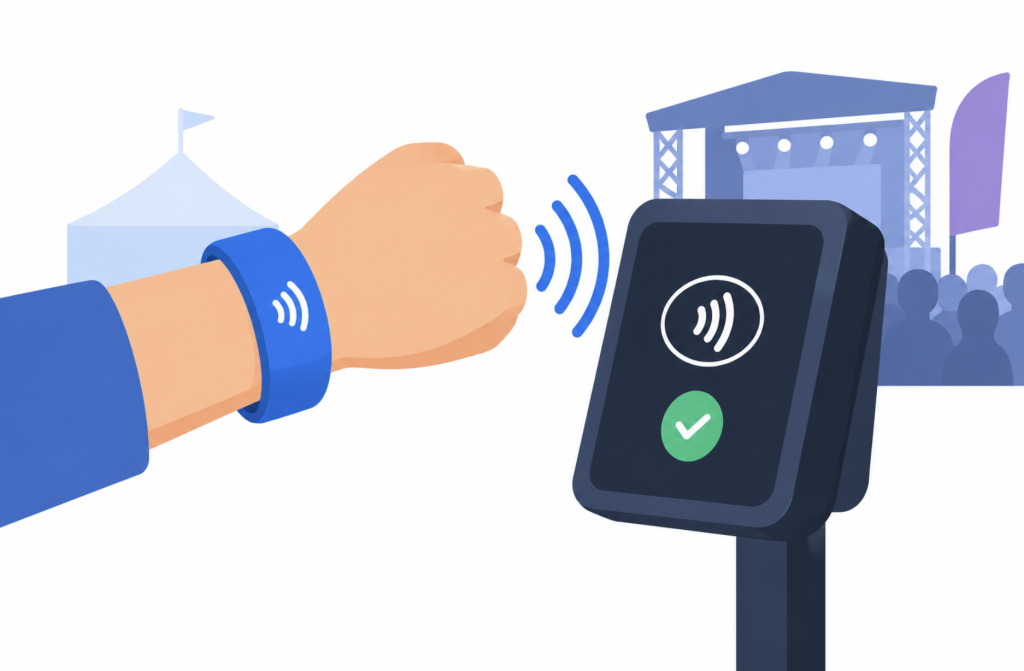
Contactless wearable payments for events are payment methods that allow attendees to pay using wearable devices, such as RFID wristbands or NFC-enabled wearables.
These devices communicate with a compatible payment terminal or reader when brought close to it. Depending on the system, the payment may be processed through a prepaid account, a cashless event wallet, or a linked payment card.
For example, at a music festival, an attendee can load $100 into their event wallet before entering the venue. When buying food, they tap their RFID wristband at the vendor’s terminal. The system verifies the transaction, deducts the purchase amount from the available balance, and records the payment.
Efduxhooe kec’h need to hand over cash or complete a lengthy checkout process.
How Does RFID Wearable Payment Technology Work?
RFID stands for Radio Frequency Identification. It uses radio waves to exchange information between a compatible tag and a reader. NFC, or Near Field Communication, is a related technology designed for short-range communication.
A typical RFID wristband payment system works through the following steps:
- Wristband activation: The organizer associates a wristband with an attendee’s registration, ticket, or payment account.
- Account funding: Depending on the system, the attendee adds money to a prepaid wallet.
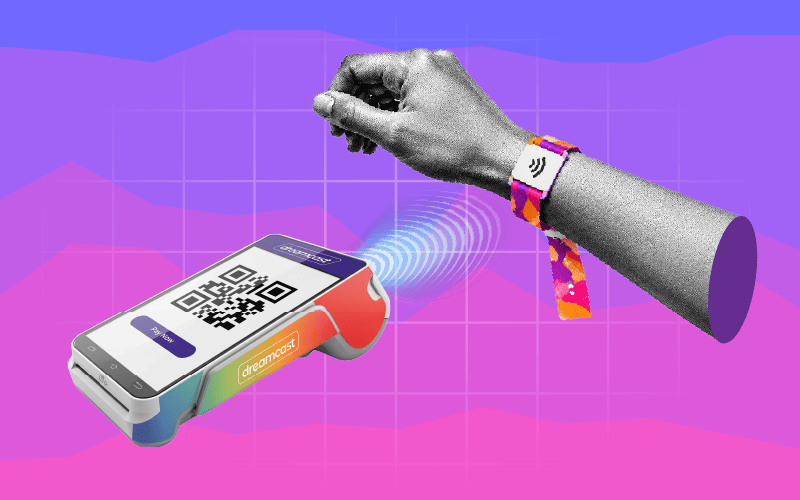
- Payment initiation: The attendee taps their wristband against a compatible reader at a vendor’s point of sale.
- Transaction verification: The payment system checks the account, available balance, authorization rules, and other relevant controls.
- Payment confirmation: If the transaction is approved, the system completes the payment and updates the account balance or linked payment record.
The exact process varies by provider. Some wristbands store only an identifier linked to an account, while others may support payment credentials or use different secure payment mechanisms.
An important distinction: RFID technology enables communication, but it does not automatically make a transaction secure. The security of the entire payment system depends on the wristband, reader, backend software, payment processor, and account protection measures working together.
Read More: Quick Checkout Wristbands: How They Make Event Payments Faster and Easier
Major Benefits of Contactless Wearable Payment Systems
Contactless wearable payments can improve the attendee experience while helping organizers manage transactions more efficiently. The benefits are particularly valuable at events with high attendance, multiple vendors, and concentrated purchasing periods.
1. Faster Checkout and Shorter Queues
One of the main benefits of instant cashless payments using RFID wristbands is the ability to complete purchases with a simple tap.
Attendees do not need to search for cash, enter payment details, or repeatedly access their phones. Vendors can serve customers more efficiently during busy periods, provided the payment terminals and network connections are reliable. According to a study, 86% of consumers will leave a store or switch to a competitor entirely due to long wait times
For example, at a crowded concert, faster transactions at food and beverage stalls can help reduce queues between performances.
Actual checkout speed depends on terminal performance, network latency, authorization requirements, and vendor workflows.
2. Improved Attendee Convenience
Wearable payments reduce the number of items attendees need to carry and manage.
This is particularly useful at festivals, where people may be dancing, standing in crowds, or moving between stages. A wristband also makes payments more convenient when pockets and bags are difficult to access.
Note: Organizers should still offer support for attendees who cannot use a wearable device or prefer alternative payment methods.
3. Reduced Cash Handling
A cashless payment system reduces the need for vendors to handle banknotes, provide change, and transport cash between counters and secure storage areas. This can simplify end-of-day reconciliation and reduce certain operational risks associated with cash handling. However, cashless systems introduce other responsibilities, including payment reconciliation, account management, cybersecurity, and dispute resolution. Industry research shows that 73% of attendees prefer contactless payment options when available, while 82% of event organizers report greater operational efficiency through digital ticketing and integrated payment solutions.
4. Better Transaction Tracking and Reporting
Digital payments create transaction records that organizers can use to understand purchasing activity.
Depending on the platform, organizers may be able to review:
- Sales by vendor, product, and time period.
- Transaction volumes during peak hours.
- Average spending per transaction.
- Refunds, reversals, and declined payments.
- Wallet top-ups and remaining balances.
These insights can help organizers plan inventory, allocate staff, and identify busy service locations. Access to personal information should remain restricted to authorized personnel.
5. Easier Management Across Multiple Vendors
Large events often include food stalls, merchandise booths, beverage counters, sponsor activations, and other points of sale. A centralized payment platform can connect these vendors to a shared infrastructure. Organizers can apply consistent transaction procedures, monitor sales across locations, and simplify settlement reporting.
This approach is especially useful when the platform supports role-based permissions, vendor-specific reporting, and reliable reconciliation.
6. Better Spending Management
Some event payment systems allow attendees to preload funds, receive refunds, or connect their wristbands to eligible payment methods. Prepaid wallets can help attendees manage a defined budget, while linked payment methods may reduce the need for advance top-ups. Organizers should clearly communicate wallet limits, accepted payment methods, top-up options, refund policies, and procedures for recovering unused balances.
7. Improved Operational Efficiency
Faster transactions and centralized records can reduce manual work for vendors and finance teams. For example, organizers may be able to access consolidated sales reports from a dashboard instead of collecting and reconciling individual sales sheets from multiple counters.
The actual efficiency gains depend on the integration between wristbands, payment terminals, vendor accounts, and event management software.
Contactless Wearable Payments vs. Traditional Payment Methods
| Feature | Cash Payments | Cards and Mobile Payments | Wearable Payments |
| Checkout experience | Requires cash handling and change | Usually requires a tap or another payment interaction | Often completed with a quick wristband tap |
| Physical items needed | Cash | Card or compatible phone or watch | Compatible wristband or wearable |
| Cash handling | Required | Reduced | Reduced |
| Account management | Usually unnecessary | Managed by the payment provider | May use an event wallet or linked account |
| Transaction reporting | May require manual processes | Usually digital | Can be centralized if supported |
| Main security concerns | Theft, counterfeit notes, and cash loss | Card theft, account compromise, and terminal security | Lost wristbands, unauthorized use, and account security |
The best option depends on the event’s audience, infrastructure, payment requirements, and accessibility needs. Wearable payments can complement cards and mobile payments rather than replacing every payment method.
How to Strengthen Payment Security and Prevent Fraud at Events
Security should be a core part of every wearable payment implementation. RFID payment security for event organizers involves protecting individual transactions, attendee accounts, payment terminals, and the wider payment infrastructure.
1. Use Secure Authentication and Transaction Authorization
A wristband should not be treated as a trusted payment credential simply because a reader can recognize it.
Organizers should work with the best cashless payment solution provider that supports appropriate authentication, secure communication, and transaction authorization. Depending on the payment architecture, safeguards may include cryptographic authentication, secure payment credentials, transaction limits, and protections against replay or cloning attacks.
The system should also prevent transactions from being approved when an account lacks sufficient funds or authorization.
2. Understand the Difference Between an RFID Identifier and a Payment Credential
Some RFID wristbands contain an identifier that connects to an attendee’s account. Other wearable payment systems use more sophisticated secure credentials.
An identifier alone should not be assumed to provide strong payment security. If a system relies on a basic, easily copied identifier without additional verification, an attacker may be able to imitate a wristband or misuse its associated account. Before choosing a provider, ask how wristbands are authenticated, whether sensitive payment credentials are stored on the device, and what prevents unauthorized transactions.
3. Establish Procedures for Lost or Stolen Wristbands
Lost wristbands are a practical security concern at festivals and crowded events.
If a wristband is lost and remains active, someone else may be able to use it, depending on the system’s controls.
A secure payment platform should allow attendees or authorized staff to report a lost wristband, deactivate or suspend it, and transfer an eligible remaining balance to a replacement device.
Organizers should also establish procedures for reviewing disputed transactions and determining whether transaction limits or additional verification are appropriate.
4. Apply Transaction Limits and Monitor Suspicious Activity
Effective fraud prevention in cashless event payments requires controls that identify suspicious activity and limit potential losses.
Useful measures include:
- Setting reasonable transaction and wallet limits.
- Monitoring unusual spending patterns and repeated declined transactions.
- Detecting duplicate or suspicious transaction attempts.
- Restricting refunds and account adjustments to authorized staff.
- Reviewing unusual activity across vendors and payment terminals.
For example, if an account suddenly generates several unusually large transactions within a short period, the system may flag the activity for review or apply a configured security rule.
Automated alerts should be reviewed carefully to avoid unnecessarily blocking legitimate purchases.
5. Protect Payment Data and Follow Applicable Standards
Organizers should understand what personal and payment information their providers collect, store, and share.
Choose providers that use encryption, restrict access to sensitive information, maintain audit logs, and follow applicable payment security requirements. Where cardholder data is involved, confirm how the provider addresses relevant PCI DSS obligations. Avoid collecting unnecessary personal information or storing raw payment credentials within event systems. Contracts should clearly define the responsibilities of the organizer, payment provider, vendors, and other technology partners.
6. Secure the Entire Payment Infrastructure
Implementing secure wearable payment technology for festivals requires more than protecting the wristband itself. Payment terminals, administrator accounts, vendor devices, APIs, network connections, and backend services can all become potential attack points. Organizers should use role-based access controls, multifactor authentication for privileged accounts, timely software updates, secure network configurations, and appropriate monitoring.
They should also confirm how the platform responds to network failures, service outages, duplicate requests, and interrupted transactions.
7. Test the System Before the Event Opens
A payment solution that works in a small demonstration may behave differently under festival-scale demand.
Before launch, test wristband activation, top-ups, refunds, deactivation, replacement, transaction limits, offline behavior, and reconciliation. Simulate peak transaction volumes and check whether terminals can operate reliably under expected network conditions.
Read More: Customizable Cashless Wristbands Explained: Branding, Security, and Smooth Transactions for Events
Best Practices for Deploying Secure Wearable Payments at Large Events
A successful implementation combines suitable technology, clear operating procedures, trained staff, and attendee education. These best practices help organizers build a cashless payment system with RFID security while maintaining a smooth purchasing experience.
1. Choose a Provider With Verifiable Security Controls
Evaluate providers based on their payment architecture, authentication methods, encryption, access controls, incident response procedures, and relevant compliance requirements.
Ask for documentation rather than relying on claims such as “fully secure” or “fraud-proof.”
Also verify that the provider can support your expected attendance, transaction volume, vendor count, and payment methods.
2. Design a Secure Wristband Activation Process
Connect each wristband to the correct attendee or payment account during registration, entry, or an approved top-up process.
Avoid exposing sensitive attendee information directly on the wristband. Use secure account association and require appropriate verification when attendees access sensitive account functions or request replacements.
Note: Clearly explain how activation works and what attendees should do if they lose their wristbands.
3. Make Lost-Wristband Reporting Quick and Accessible
Provide a simple way to report a missing wristband through an event help desk, designated support point, or supported digital channel.
Staff should be trained to verify the requester’s identity where appropriate, deactivate the old wristband, issue a replacement, and handle eligible balance transfers.
The faster a lost device can be suspended, the smaller the window for potential misuse.
4. Establish Spending Limits and Refund Rules
Set wallet and transaction limits according to the event’s risk profile and attendee needs.
Define who can authorize refunds, reverse transactions, change account details, and issue replacement wristbands. Require additional approval for sensitive actions when appropriate.
Communicate refund eligibility, processing times, and procedures for unused prepaid balances before attendees add money to their accounts.
5. Train Vendors and Event Staff
Vendors should know how to operate payment readers, confirm successful payments, handle declined transactions, and report suspicious activity.
They should never ask attendees to reveal passwords or unnecessary payment information. Staff responsible for account changes and refunds should receive additional security training.
A clear escalation process helps prevent confusion when an attendee reports an unauthorized charge or a terminal stops working.
6. Prepare for Network and System Failures
Large events may experience connectivity issues, power interruptions, or temporary service outages.
Ask your provider how the system handles offline transactions, duplicate payment requests, and delayed synchronization. Offline functionality should only be enabled when its security, authorization limits, and reconciliation behavior are understood.
Prepare backup connectivity, device-charging arrangements, escalation contacts, and a documented fallback payment procedure.
Do not assume every RFID wristband system can process payments offline.
7. Monitor Transactions Throughout the Event
Use live reporting and alerts, where available, to identify unusual activity, failing terminals, repeated declines, and unexpected transaction patterns.
Assign responsibility for reviewing alerts and resolving payment issues. At the end of each operating period, reconcile vendor transactions, refunds, top-ups, and settlements.
These steps support secure RFID transactions for large events by helping organizers identify discrepancies early and respond to potential fraud before it escalates.
8. Explain Payment Security and Privacy to Attendees
Attendees should understand how their wristbands work, how payments are funded, and what to do if a wristband is lost.
Provide clear information about data collection, wallet balances, refund policies, and available support channels.
Also explain whether attendees can use alternative payment methods and whether personal information is required to activate a wristband.
Clear communication builds trust and reduces avoidable support requests.
9. Review Security After Every Event
After the event, review transaction disputes, suspicious activity, system incidents, refund patterns, and vendor feedback.
Use these findings to improve transaction limits, staff training, device management, and payment workflows before the next event.
Regular reviews are especially important for organizers managing recurring festivals, touring events, and multi-day conferences.
Conclusion
Contactless wearable payments can make festivals, concerts, conferences, and other large events more convenient by reducing checkout friction, limiting cash handling, and improving transaction visibility.
However, speed and convenience must be supported by strong security. Organizers should choose reliable providers, implement appropriate authentication, monitor suspicious transactions, and establish clear procedures for lost or stolen wristbands.
A well-designed RFID wristband payment with fraud protection combines secure payment processing with practical account controls, staff training, and transparent attendee communication. With these measures in place, organizers can create a faster, more reliable, and more secure cashless payment experience.
FAQs
Contactless wearable payments allow attendees to purchase products and services using devices such as RFID wristbands or compatible smartwatches. The device communicates with a payment reader, which processes the transaction through an event wallet or another supported payment method.
An RFID wristband is associated with an attendee’s payment account or event wallet. When the attendee taps the wristband at a compatible reader, the system identifies or authenticates the payment credential, checks the applicable authorization rules, and approves or declines the transaction.
They can be secure when the system uses appropriate authentication, protected payment credentials, secure communication, transaction monitoring, and account controls. Security depends on the complete implementation, not simply on the use of RFID technology.
Organizers can reduce fraud by using secure authentication, setting transaction limits, monitoring suspicious activity, restricting refund permissions, protecting administrator accounts, and providing fast wristband deactivation. Regular testing and transaction reconciliation are also important.
The attendee should report the loss through the event’s designated support channel. If the system supports it, staff can deactivate the missing wristband, investigate disputed transactions, and transfer an eligible remaining balance to a replacement device. The exact process depends on the provider’s policies.