



TL;DR:
An anti-fraud cashless payment system for events combines contactless payments, transaction tracking, payment confirmations, and appropriate security controls to help organisers reduce financial risks. RFID/NFC wristbands, reliable reporting, staff access controls, and clear procedures for disputed payments can make festival payments easier to manage and investigate.
Introduction
Cashless payments remove the need to count every note at the counter. They don’t remove the need to account for every sale.
For event organisers, that distinction matters. A festival might have dozens of vendors, multiple payment points, temporary staff, and a constant stream of transactions. Moving to RFID wristbands or contactless payments can simplify checkout, but financial oversight still depends on what happens behind each tap: how the payment is recorded, who can access the system, and whether the event team can investigate a discrepancy.
An effective anti-fraud cashless payment system for events addresses those operational realities. It combines convenient payment methods with appropriate security measures and transaction visibility, helping organisers manage financial risks without making the payment experience unnecessarily complicated for attendees.
The wider cybersecurity environment also makes access controls and data protection important considerations. The UK government’s Cyber Security Breaches Survey 2025/2026 found that 43% of UK businesses had experienced a cyber security breach or attack in the previous 12 months. This figure covers businesses generally, not event payment systems specifically, but it highlights why security should be part of operational planning.
Where Can Payment Fraud and Errors Occur at Events?
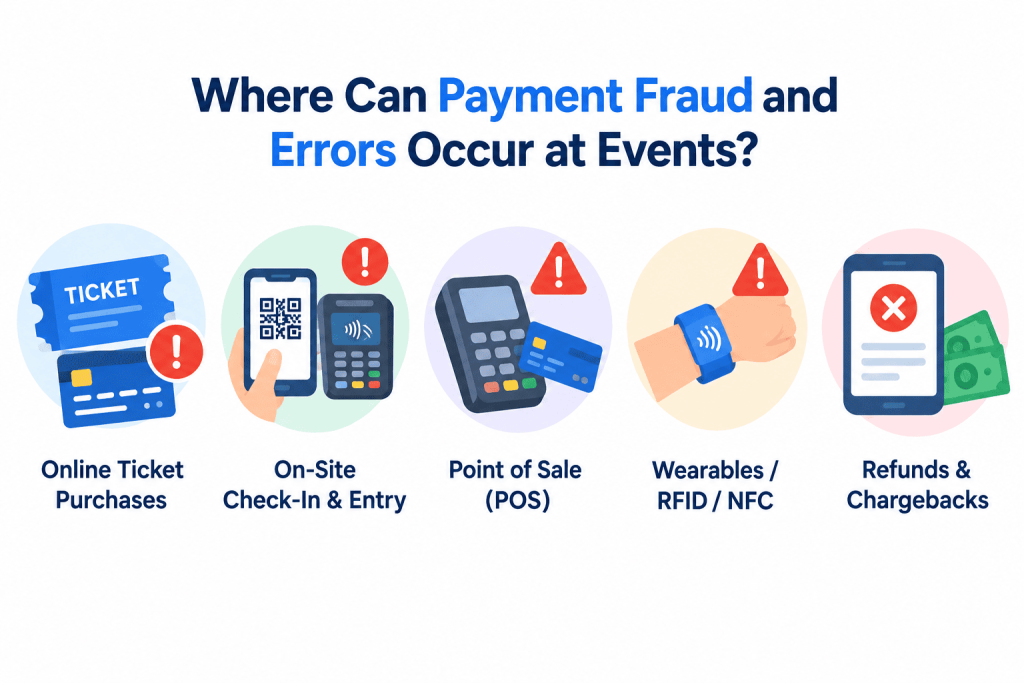
Payment issues do not always involve deliberate fraud. They can also arise from incorrect transactions, weak access controls, poor reconciliation, or gaps in staff procedures. Understanding where problems can occur helps organisers choose suitable safeguards.
- Lost or misused payment devices: If an attendee’s RFID wristband or other payment credential is lost or compromised, organisers need a clear process for reporting the issue and restricting further use where the system supports it.
- Unexplained transactions: Differences between sales records and the money collected can make it difficult to identify whether a transaction was entered incorrectly, recorded twice, or handled improperly.
- Unauthorised system access: Shared credentials or excessive staff permissions can allow people to access functions or information they do not need for their roles.
- Duplicate or incorrect payments: Mistakes at busy counters may result in duplicate charges, incorrect amounts, or disputes that require transaction records to resolve.
- Connectivity and device problems: Network interruptions or payment-terminal issues can create uncertainty about whether a transaction succeeded. Staff need clear procedures for checking payment status before attempting it again.
These risks call for more than a convenient payment method. Organisers need a system and operating process that make transactions traceable, limit unnecessary access, and provide a clear way to investigate exceptions.
Features That Make an Event Payment System More Secure
Not every cashless solution provides the same safeguards. When comparing options, event organisers should look beyond payment speed and examine how the system handles credentials, records, staff access, and operational exceptions.
1. Secure RFID and Contactless Payments
An RFID wristband can let attendees pay by tapping at a compatible point of sale instead of handling cash. As an instant payment wearable for festivals, it can make checkout more convenient at events with multiple food, beverage, and merchandise vendors.
However, RFID technology alone does not guarantee fraud prevention. Security also depends on how credentials are linked to accounts, how transactions are authorised, and what happens when a wristband is lost or suspected of misuse.
When evaluating a secure RFID wristband payment solution or an RFID wristband with secure payments, ask the provider:
- How are wristbands or other payment credentials associated with an attendee’s account?
- Can a lost or compromised credential be blocked or deactivated?
- What verification or authorization controls apply to transactions?
- What procedures are available for disputed or unauthorised payments?
The answers should reflect the provider’s actual capabilities rather than assumptions about what RFID technology automatically delivers.
For a closer look at the implementation process, explore How to Implement RFID Cashless Payments at Events, including the practical considerations for setting up RFID-based event payments.
2. Data Protection and Secure Processing
Cashless systems may handle personal information alongside payment-related records. Organisers should understand what information is collected, how it is protected, who can access it, and how long it is retained.
The UK government’s Cyber Security Breaches Survey 2025/2026 reported that 14% of businesses held personal data that was not protected using techniques such as anonymisation or encryption. This is a general business finding, not a measure of event payment security, but it reinforces the importance of reviewing data-handling practices.
Before choosing a provider, look for clear information about:
- Data encryption and other relevant security safeguards.
- User authentication and account protection.
- Data access, retention, and deletion policies.
- Responsibilities for handling a suspected data breach.
- Compliance with applicable data-protection requirements.
The Information Commissioner’s Office guidance on data security provides UK organisations with guidance on protecting personal data and applying appropriate security measures.
3. Transaction Records and Reporting
A payment system should give authorised staff access to records that help them understand what happened during a transaction. These records are useful when investigating a disputed payment, reconciling vendor sales, or reviewing unusual activity. Depending on the system, reporting may provide information such as transaction amounts, timestamps, payment locations, and sales by vendor or terminal.
When assessing an anti-fraud cashless payment system for events, check whether it allows your team to:
- Review individual transactions when a discrepancy is reported.
- Compare sales across vendors and payment points.
- Reconcile transaction records against operational reports.
- Export relevant records for accounting or investigation.
- Restrict access to financial reports to authorised personnel.
Reporting does not automatically prevent fraud, but reliable records can make errors and suspicious activity easier to investigate.
4. Payment Confirmations and Receipts
Clear transaction feedback helps both attendees and event staff understand whether a payment has gone through. Without it, an attendee may try to pay again or challenge a charge they do not recognise.
A well-defined payment process should make the transaction outcome clear and provide a way to check the record when a problem occurs. Depending on the solution, confirmations or receipts may be available digitally or through the point-of-sale process. Organisers should confirm which receipt and confirmation options the provider supports and how staff can look up a disputed transaction.
5. Offline Payment Procedures
Temporary connectivity problems can affect payment operations at outdoor festivals, remote venues, or crowded event sites. The important question is not simply whether a system works offline, but how it behaves when a connection is lost and restored.
Offline payment capability varies by provider. Some systems may support particular offline transactions, while others require a connection. Organisers should establish what happens to transaction authorisation, records, and synchronisation before relying on offline functionality.
Ask the provider:
- Which transactions, if any, can be processed without connectivity?
- Are there transaction limits or restrictions in offline mode?
- How are offline records synchronised when the connection returns?
- How can staff confirm whether a payment succeeded and avoid duplicate charges?
If offline processing is unavailable, prepare a clear contingency procedure for temporary outages. Staff should know when to retry, when to check transaction status, and how to escalate unresolved payments.
6. Staff Permissions and Access Controls
Event payment operations often involve permanent employees, temporary staff, vendor teams, and supervisors. Not everyone needs access to the same functions or financial information.
Role-based permissions can help limit access to the tasks each person needs to perform. For example, a vendor may need to process sales, while a manager may need access to reconciliation reports or administrative settings.
The UK government’s Cyber Security Breaches Survey 2025/2026 found that 73% of businesses had restricted administrator rights as a cybersecurity measure. Although this is not an event-specific statistic, it illustrates the importance of limiting privileged access.
For event payment operations:
- Give each staff member an appropriate account where the system supports individual accounts.
- Limit administrative access to designated personnel.
- Avoid sharing credentials across vendors or teams.
- Remove or update access when staff leaves, or their responsibilities change.
- Review permissions before the event and after major staffing changes.
These measures help reduce the risk of accidental changes, unauthorised access, and difficulties tracing actions to the appropriate user.
Best Practices for Preventing Payment Fraud at Festivals
Clear procedures and staff training help organisers manage payment risks before, during, and after an event.
Set Up Controls Before the Event
Test payment terminals, user accounts, and reporting functions. Establish procedures for lost wristbands, failed transactions, refunds, and suspected misuse.
Train Staff to Handle Exceptions
Train staff to verify payment status before retrying transactions, handle errors, and escalate unresolved issues to a supervisor.
Reconcile Transactions Regularly
Review transaction records and vendor totals during the festival. Investigate discrepancies promptly and document corrections or refunds.
Prepare a Lost-Wristband and Dispute Process
Provide a clear way to report lost wristbands or unrecognised payments. Explain how credentials can be blocked or replaced, where supported, and document actions taken.
Review Security After the Event
Reconcile sales, resolve outstanding disputes, remove temporary staff access, and use recorded incidents to improve future payment procedures.
How to Choose the Right Anti-Fraud Payment Solution for Festivals
The right solution should fit the event’s scale, payment environment, and operational requirements. A large festival with multiple vendors may need different reporting and access arrangements from a smaller event with a handful of payment points.
Before making a decision, assess the following:
| What to assess | Questions to ask |
| Payment methods | Does the system support the payment credentials and devices your event needs? |
| Security controls | How are credentials protected, and how can lost or compromised devices be restricted? |
| Transaction visibility | Can authorised staff review transactions and reconcile vendor sales? |
| User permissions | Can access be limited according to staff roles? |
| Connectivity | What happens during an outage, and are any offline transactions supported? |
| Dispute handling | What procedures are available for incorrect, duplicate, or unrecognised payments? |
| Data protection | What personal data is collected, and what safeguards and retention policies apply? |
| Support | What assistance is available during setup and live event operations? |
Ask providers to demonstrate security features and clarify which functions are included, require configuration, or are unsupported.
For large-scale events, How to Manage Event Payments for 50,000+ Event Attendees offers further guidance on payment operations, security controls, and preparing for connectivity issues.
A secure RFID payment system for events should balance fast checkout with traceable transactions and practical security controls. Explore Dreamcast’s cashless payment solution to assess whether its capabilities fit your event’s payment and operational requirements.

Make Every Event Transaction Easier to Track!
A cashless payment system can make event transactions quicker to process, but reliable financial oversight depends on more than the payment method. Organisers need clear records, suitable access controls, sensible procedures for disputed transactions, and a plan for connectivity or device problems.
Before selecting an anti-fraud payment solution for festivals, check how it handles the situations that are most likely to challenge your team: a missing wristband, an unexplained transaction, a staff access issue, or a payment terminal that stops responding. Choosing a system with appropriate safeguards and preparing staff to use it correctly can make payments easier to manage throughout the event.
Frequently Asked Questions
Ans. It combines cashless payments with security controls and transaction tracking to help organisers monitor payments, manage access, and investigate suspicious activity or discrepancies.
RFID wristbands simplify checkout, but they cannot prevent every type of fraud on their own. Security also depends on account controls, transaction authorisation, reporting, and procedures for lost or compromised wristbands.
Review transaction records, follow the provider’s dispute process, and block or deactivate compromised credentials if supported. Document the actions taken and explain the available resolution options to the attendee.
It depends on the provider and system configuration. Some support limited offline processing, while others require connectivity. Confirm offline capabilities, transaction synchronisation, and outage procedures before the event.