

TL;DR Pointers
- Before selecting a provider, evaluate scalability, connectivity, security, integrations, reporting, vendor support, pricing, and onsite assistance.
- Cashless payment systems simplify event payments by replacing physical cash with RFID, NFC, QR codes, cards, UPI, or digital wallets.
- Key features to look for include fast POS transactions, offline payment capability, real-time reporting, attendee wallet management, inventory tracking, vendor settlement, security, and refund management.
- The biggest benefits include shorter queues, faster transactions, better attendee experience, reduced cash handling, and improved financial visibility.
- Choosing the right technology matters: RFID, NFC, and QR payments suit different event formats, audiences, and operational requirements.
Introduction
A cashless payment system for events replaces or reduces physical cash by letting attendees pay through RFID or NFC wristbands, cards, QR codes, cards, UPI, or other digital payment methods. For organizers, the value goes beyond faster payments.
A well-designed system can reduce queues, simplify vendor transactions, provide real-time sales data, improve payment security, support offline transactions, and make reconciliation easier. The right solution should match your event size, audience, vendors, payment model, connectivity, security requirements, and reporting needs.
Key Advantages of Cashless Payment System
Convenience and Accessibility:
One of the most prominent features of cashless payment systems is their unparalleled convenience and accessibility. With the proliferation of smartphones and digital devices, individuals can now make payments anytime, anywhere, with just a few taps on their screens. Whether it’s purchasing goods online, paying bills, or splitting a restaurant tab with friends, cashless payment systems offer unparalleled convenience. This eliminates the need to carry physical currency or visit brick-and-mortar banks.
Enhanced Security:
Another key feature of cashless payment systems is their robust security measures. This help protect users’ financial information from unauthorized access and fraudulent activities. Advanced encryption techniques and multi-factor authentication mechanisms ensure that transactions are secure and tamper-proof, instilling confidence among consumers and businesses alike. Moreover, the ability to track and monitor transactions in real-time allows for the timely detection and mitigation of suspicious activities. Furthermore, enhancing the security of cashless payment systems.
Speed and Efficiency:
A Cashless payment system is renowned for its speed and efficiency, facilitating swift and seamless transactions. This enables businesses to operate more efficiently and customers to enjoy faster checkout experiences. Unlike traditional cash-based transactions, which often involve time-consuming manual processes such as counting and verifying currency, cashless payments can be completed instantaneously. Thereby, reducing waiting times and enhancing overall productivity.
Integration and Compatibility:
One of the most compelling features of modern cashless payment systems is their integration and compatibility with a wide range of platforms, devices, and payment methods. Whether it’s cashless cards, mobile wallets, or digital currencies, cashless payment solutions support diverse payment options. This allows users to choose the method that best suits their preferences and needs. Furthermore, the seamless integration of a cashless payment platform with existing infrastructure such as point-of-sale (POS) terminals and online payment gateways ensures a smooth and hassle-free user experience across various channels.
Scalability and Flexibility:
Cashless payment cards offer unparalleled scalability and flexibility, catering to the needs of businesses of all sizes, from small startups to multinational corporations. Whether it’s processing a handful of transactions or handling millions of payments per day, cashless payment solutions can effortlessly scale to accommodate growing transaction volumes. Thereby, enabling businesses to expand their operations without constraints. Moreover, the flexibility inherent in cashless payment systems allows businesses to tailor their payment solutions to meet specific requirements and preferences. Whether it’s implementing loyalty programs, offering installment plans, or integrating with third-party applications.
Cost Savings and Efficiency Gains:
By eliminating the need for physical cash handling and streamlining transaction processes, cashless payment cards offer significant cost savings and efficiency gains for businesses and financial institutions. Reduced cash handling costs, lower risk of theft and fraud, and increased operational efficiency translate into tangible bottom-line benefits. This enables businesses to reinvest savings into growth initiatives and value-added services. Additionally, the digitization of payments facilitates automated reconciliation and reporting, minimizing manual errors and administrative overheads, further enhancing cost-effectiveness and efficiency.
Learn more: The Impact of Cashless Payments on Events
What Is a Cashless Payment System for Events?
A cashless payment system for events allows attendees to make purchases without relying on physical cash.
Depending on the event and payment model, attendees may pay using:
- RFID wristbands or cards
- NFC-enabled cards or devices
- QR codes
- Debit or credit cards
- UPI
- Digital wallets
- Event-specific prepaid wallets
Instead of handling cash at every food, beverage, merchandise, or activity counter, transactions are processed digitally.
For event organizers, this creates more than a convenient payment experience. It can also make it easier to manage transactions, monitor sales, control vendors, and understand how attendees spend during the event.
A modern event cashless system can also support features such as real-time reporting, inventory management, remote recharges, tax-compliant billing, and offline payment processing.
But how does the process actually work?
How Does a Cashless Payment System Work at an Event?
Although the technology behind it can be complex, the attendee experience can be very simple.
1. Issue an RFID, NFC, or Other Payment Credential
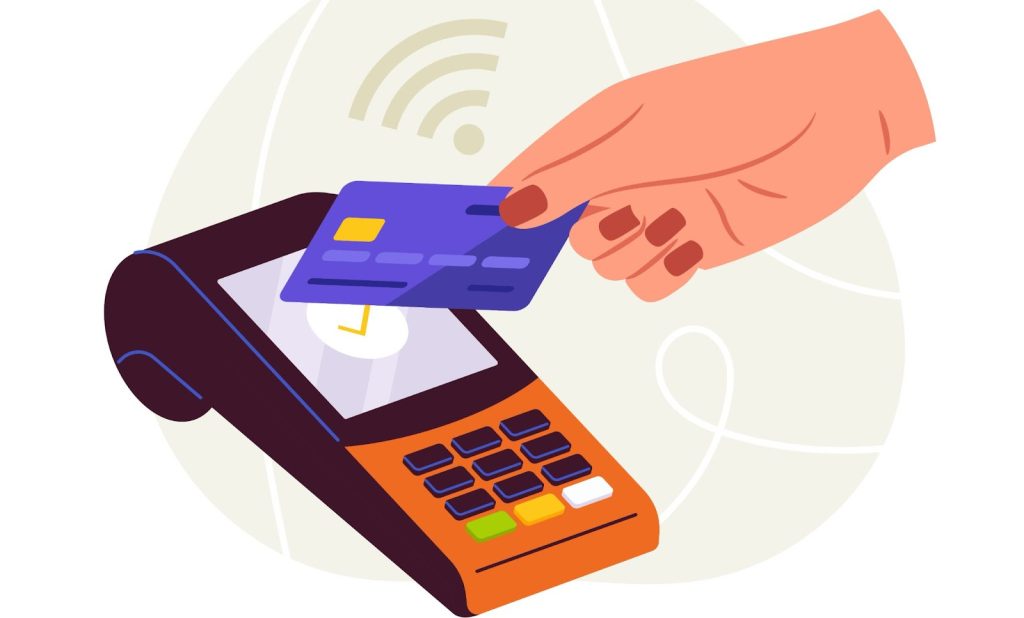
Depending on the payment model, attendees receive an RFID/NFC wristband, card, QR code, or another payment method.
For example, an RFID wristband can work as an event credential and payment tool.
2. Add Funds or Connect a Payment Method
Attendees can add money to their event wallet or use a supported payment method directly.
Top-ups may happen through onsite recharge counters, mobile devices, payment cards, UPI, and other supported digital payment methods.
3. Tap, Scan, or Pay
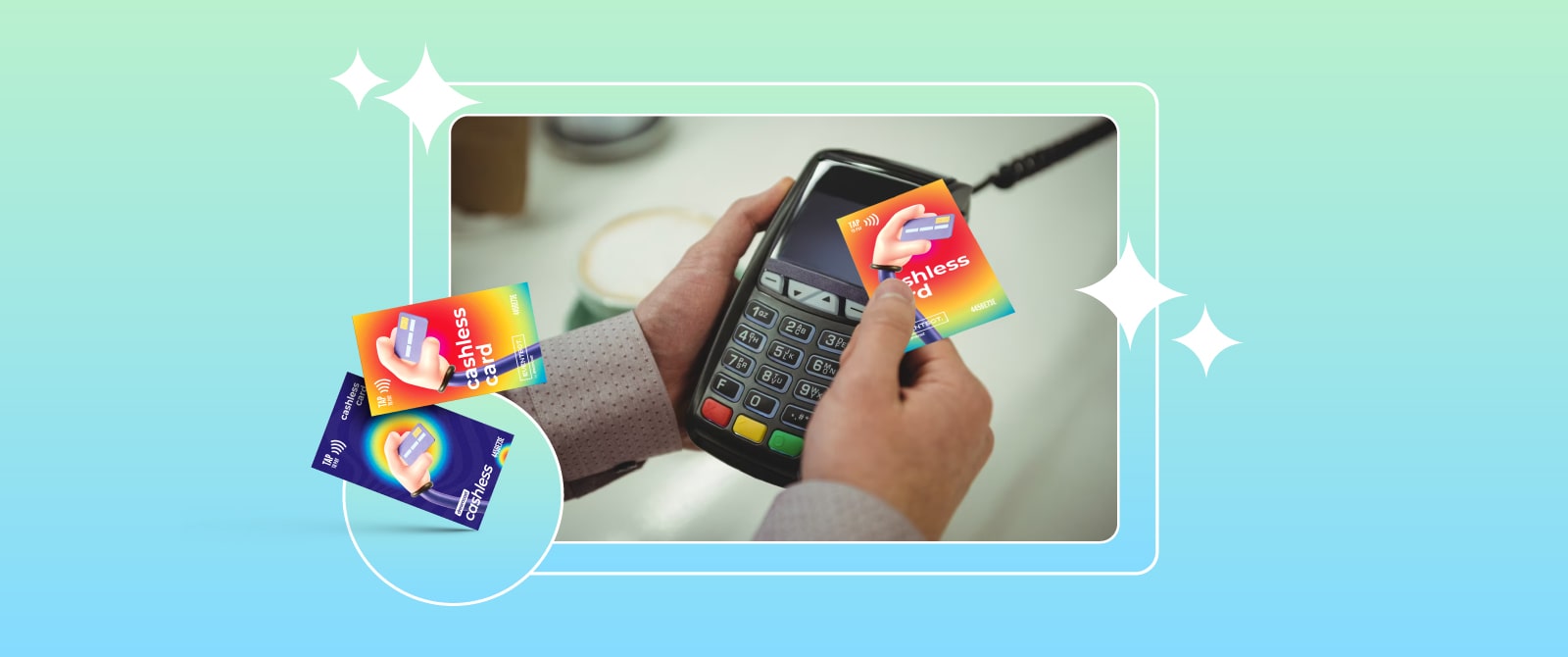
When attendees purchase food, drinks, merchandise, or other services, they tap their wristband/card or use the supported payment method at the point of sale.
The goal is to make this interaction as quick as possible.
4. The Transaction Is Recorded
The payment system records the transaction and updates the relevant balance or payment record.
5. Organizers Monitor Activity
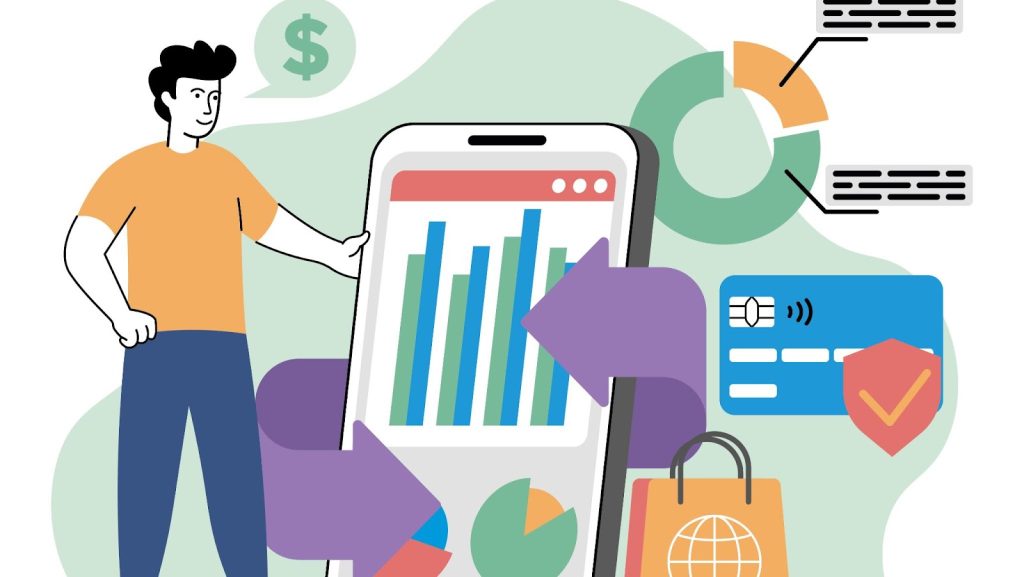
Organizers and authorized teams can access transaction information and reports to understand sales, vendor performance, and attendee spending.
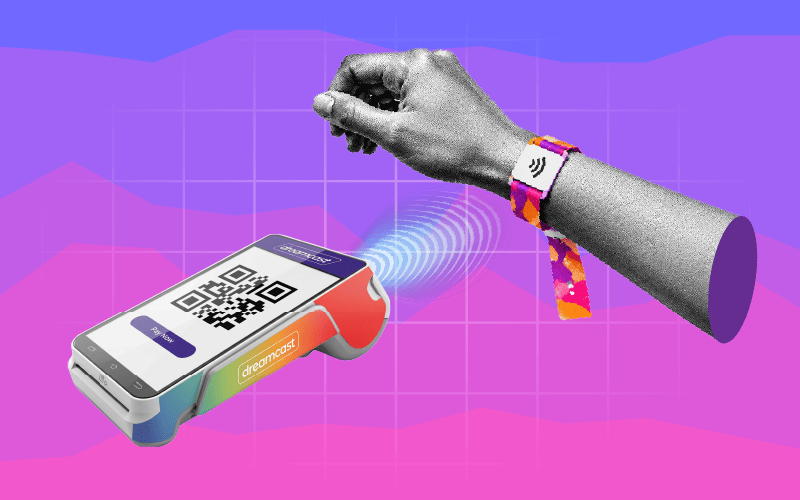
Dreamcast’s current cashless workflow follows this general model: issue an RFID/NFC wristband or card, top up, tap and pay, then access real-time transaction insights and reports.
What Features Should a Cashless Event Payment System Have?
Not every event needs exactly the same features. A 500-person conference may have very different requirements from a 50,000-person festival.
However, these are the features worth evaluating when comparing providers.
1) RFID and NFC Payment Support
RFID and NFC can make contactless event payments quick and convenient.
An attendee can tap an enabled wristband or card instead of searching for cash or repeatedly entering payment details.
This can be particularly useful for festivals, concerts, exhibitions, sports events, and other environments where many people make purchases within a short period.
However, RFID and NFC should not automatically be treated as interchangeable. Your choice should depend on your event format, infrastructure, credential requirements, and payment model.
2) Multiple Payment Methods
Your audience may have different payment preferences.
A flexible system can support multiple options such as RFID, NFC, QR, Debit and credit cards, UPI, and Digital wallets.
This gives organizers more flexibility when designing the payment journey.
For example, Dreamcast’s cashless platform supports payment acceptance through UPI, debit cards, and credit cards alongside its event cashless infrastructure.
3) Fast Point-of-Sale Transactions
At a busy event, payment speed becomes an operational issue.
If one transaction takes too long, queues build up. When hundreds of people are waiting at a food or merchandise counter, even a small delay can affect the overall attendee experience.
Look for a system that supports:
- Quick tap-and-pay transactions
- Easy-to-use POS devices
- Fast transaction confirmation
- Multiple payment points
- Reliable processing during peak periods
The objective is simple: make payment the shortest part of the purchase journey.
4) Offline Payment Capability
Internet connectivity is not always predictable at events.
Outdoor festivals, large venues, crowded locations, and temporary event infrastructure can all experience network problems.
A cashless system with offline payment capability can allow transactions to continue during temporary connectivity interruptions, depending on how the provider has designed the system.
Dreamcast specifically lists offline payment capability as one of its cashless features.
When evaluating this feature, do not just ask whether the provider supports offline payments. You need to ask:
- What happens if a device fails?
- How are offline transactions stored?
- Are transaction limits available?
- How are transactions synchronized?
- How are duplicate transactions prevented?
Learn more: How Cashless Payments Are the Future of Events and Festivals
5) Real-Time Transaction Reporting
Real-time reporting gives organizers visibility into what’s happening while the event is still running.
You can use transaction data to understand:
- Which vendors are performing well
- When spending peaks
- Which products are selling
- Where queues may be forming
- How much revenue is being generated
- Whether transactions are processing normally
This is especially useful for large events where waiting until the end of the day to understand sales is not practical.
6) Attendee Wallet and Top-Up Management
If your event uses a closed-loop or prepaid payment model, attendees need an easy way to add and manage funds.
A good system should make it straightforward to:
- Add money
- Check balances
- View transactions
- Recharge when needed
- Handle refunds
- Manage lost credentials
Convenient top-up options can also reduce queues at recharge counters.
Some systems allow attendees to recharge remotely rather than requiring them to visit a physical counter. Dreamcast lists recharge-from-anywhere functionality as part of its cashless offering.
7) Inventory Management
Payments and inventory are closely connected at events.
Imagine a food festival where one vendor suddenly sells out of its most popular item. If the organizer has access to real-time inventory information, the team can respond much faster.
Inventory management can help you:
- Track available stock
- Monitor product sales
- Identify fast-moving items
- Reduce stockouts
- Improve replenishment decisions
Dreamcast’s cashless platform includes inventory management alongside payment and transaction tools.
8) Vendor Management and Settlement
Your vendors are an important part of the payment ecosystem. A suitable cashless platform should help you manage:
- Vendor transactions
- Sales data
- Product-level information
- Settlement records
- Payment reconciliation
- Vendor performance
This reduces the need to collect and reconcile multiple disconnected payment records after the event.
9) Secure Payment Processing
Security should be built into the system rather than treated as an optional extra. You need to look for features and controls such as:
- Encryption
- Secure authentication
- Role-based access
- Fraud prevention
- Protected payment credentials
- Transaction monitoring
- Lost credential blocking
- Controlled refunds
Dreamcast describes its cashless platform as using security measures for unauthorized transaction protection and fraud prevention.
The exact security architecture will vary between providers, so ask for specifics rather than relying on a generic “secure payments” claim.
10) Refund and Balance Management
If attendees preload money into an event wallet, your payment system needs a clear process for unused balances and refunds.
Before choosing a provider, clarify:
- When refunds can be requested
- How refunds are initiated
- Where refunds are sent
- Whether there are deadlines
- How lost credentials are handled
- How duplicate refunds are prevented
Your refund policy should be communicated clearly to attendees before and during the event.
11) Billing and Tax Support
For organizers and vendors, payment management does not end when an attendee taps to pay.
You may also need proper transaction records and tax documentation. Based on your market and event setup, useful capabilities can include:
- Itemized transaction records
- Tax invoice generation
- GST/VAT support
- Digital receipts
- Vendor settlement reports
Dreamcast lists tax invoice billing as one of its cashless transaction-management capabilities.
12) Customization and Integrations
Your cashless payment system should not necessarily operate in isolation.
Depending on your event, you may need it to work alongside event registration, ticketing, access control, CRM, accounting, inventory, reporting, and marketing systems.
Customization can also extend to attendee-facing interfaces, cards, wristbands, and branding.
The more systems you connect, the more important it becomes to understand what data is shared, how integrations work, and who owns the resulting data.
What Are the Benefits of Cashless Payments at Events?
The right cashless system can benefit organizers, vendors, and attendees at the same time.
Faster Transactions and Shorter Queues
Contactless payments can reduce the time required to complete individual purchases.
That matters when hundreds of attendees arrive at a food stall, bar, merchandise counter, or activity zone at the same time.
Faster transactions can help vendors serve more people without continuously adding payment staff.
Better Attendee Experience
Attendees do not want to spend their event experience searching for cash, counting change, or standing in unnecessary payment queues.
A simple tap, scan, or digital payment can make purchasing feel much less disruptive.
The goal is not simply to make payments digital. It’s to make payments less noticeable.
Reduced Cash Handling
Handling physical cash creates additional operational work. Organizers and vendors may need to:
- Store cash securely
- Count money
- Provide change
- Transport cash
- Reconcile multiple cash points
- Manage discrepancies
Cashless transactions reduce much of this manual handling.
Better Security
Cashless systems can reduce some risks associated with physical cash, such as theft, loss, and manual counting errors.
Digital payment systems can also provide additional controls around authentication, transaction monitoring, refunds, and access permissions.
However, going cashless does not automatically make an event secure. Security depends on the system’s architecture, configuration, and operating procedures.
Real-Time Financial Visibility
One of the biggest advantages for organizers is access to transaction data while the event is happening.
Instead of waiting for vendors to submit sales information, you can monitor payment activity and make faster operational decisions.
For example, if one vendor is processing significantly more transactions than another, you may be able to adjust staffing, inventory, or payment capacity.
Easier Vendor Reconciliation
When transaction records are captured digitally, organizers can have a clearer record of vendor activity.
This can simplify post-event reconciliation and help reduce disputes around sales figures.
More Opportunities to Increase Revenue
A smoother payment experience can remove friction from purchasing.
When attendees do not have to repeatedly handle cash or navigate complicated payment steps, additional purchases can become easier.
Cashless systems can also give organizers insight into purchasing behavior, helping them understand which products, vendors, or experiences are driving revenue.
Better Event Data
Cashless payments can generate useful operational data. Depending on the system and privacy configuration, organizers may be able to analyze:
- Transaction volumes
- Peak spending periods
- Vendor performance
- Product sales
- Average transaction values
- Spending patterns
This information can help improve future event planning.
Cash vs. Cashless Payments at Events
Still deciding whether your event should go cashless?
Here’s a quick comparison:
| Factor | Cash Payments | Cashless Payments |
| Transaction speed | Slower when counting and giving change | Typically faster with tap/scan payments |
| Queue management | Can become difficult during peaks | Faster processing can help reduce queues |
| Cash handling | High | Lower |
| Real-time reporting | Limited | Stronger visibility when supported |
| Vendor reconciliation | More manual | More automated |
| Attendee convenience | Depends on cash availability | Can support multiple digital options |
| Payment data | Limited | More transaction-level visibility |
| Security | Physical cash can be lost or stolen | Requires strong digital security controls |
| Connectivity dependence | Low | Depends on system; offline capability can reduce risk |
| Refund management | Often manual | Can be digitally managed depending on setup |
There is not one payment model that is perfect for every event.
The right choice depends on your audience, venue, infrastructure, vendors, transaction volume, and operational goals.
Bottom Line
A cashless payment system for events is about much more than replacing cash with digital transactions.
The right system, like Dreamcast Cashless, can help you speed up payments, reduce queues, improve attendee convenience, simplify vendor operations, monitor transactions in real time, manage inventory, strengthen payment security, and make post-event reconciliation easier.
But choosing the right solution requires more than looking at a list of features.
Start with your event.
Consider your attendee volume, vendors, payment points, connectivity, security requirements, payment methods, reporting needs, and budget. Then choose a system that can support the entire payment journey, from the first top-up to the final reconciliation.
That’s the difference between simply going cashless and building a better event payment experience.
FAQs
A cashless payment system allows attendees to pay for purchases without physical cash. Depending on the event, it can use RFID, NFC, QR codes, cards, UPI, digital wallets, or event-specific prepaid wallets.
Attendees receive or connect a payment credential, add funds or choose a payment method, and then tap, scan, or pay at event counters. The system records transactions and can provide organizers with real-time payment and sales data.
Look for fast POS transactions, RFID/NFC support, multiple payment methods, offline capability, real-time reporting, wallet and top-up management, vendor settlement, inventory management, security controls, refunds, and useful integrations.
Cashless payments can reduce queues, speed up transactions, reduce physical cash handling, improve attendee convenience, provide real-time financial visibility, simplify vendor reconciliation, and generate useful event data.
They can be, provided the system uses appropriate security controls such as encryption, authentication, access management, transaction monitoring, fraud prevention, and secure refund processes. Organizers should evaluate the provider’s actual security controls before deployment.
Neither is universally better. RFID can be useful for event-specific wristbands and credentials, while NFC is well suited to fast contactless interactions. Your choice should depend on event size, audience, infrastructure, payment volume, and whether you need wearable credentials.