

Music events are built around energy, movement, and memorable experiences. But long queues at food and beverage counters, slow payments, and cash-handling issues can quickly interrupt that experience.
For organizers, however, going cashless is about more than making payments faster. The right system can also help manage vendors, track sales, monitor inventory, handle refunds, and understand attendee spending.
Whether you are organizing a concert, music festival, EDM event, or multi-day festival, here’s what you need to know before implementing cashless payments.
TL;DR Pointers
- Cashless payment systems allow music-event attendees to pay for food, beverages, merchandise, and other purchases without repeatedly handling physical cash.
- RFID and NFC wristbands or cards can provide fast tap-to-pay transactions, while QR codes, cards, and digital wallets can offer additional payment flexibility.
- For organizers, the biggest advantages include faster transactions, shorter queues, better sales visibility, easier vendor management, and reduced cash handling.
- A successful system should also support top-ups, refunds, lost-credential management, security, inventory tracking, reporting, and offline transactions where required.
- Before choosing a provider, evaluate scalability, payment speed, technology options, integrations, security, support, and total cost.
What Is Cashless Payment for Music Events?
Cashless payment for music events is a digital payment setup that lets attendees buy products and services without paying cash at every transaction.
Instead of taking out a wallet each time they want a drink or merchandise, attendees can use a supported payment credential or digital method.
Depending on the system, that could include RFID wristbands, RFID cards, NFC wristbands or cards, QR codes, credit or debit cards, mobile wallets, and digital event wallets.
For example, an attendee could receive an RFID wristband when entering a festival. They can add funds to their account and then tap the wristband at a bar or merchandise stall to pay.
The transaction is recorded digitally, the balance is updated, and the organizer can access transaction information through the cashless platform.
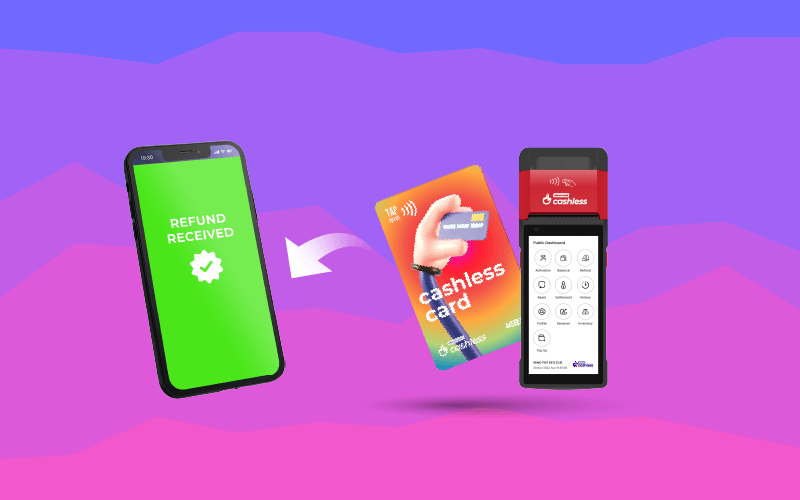
Dreamcast’s current cashless system follows a similar flow: issue an RFID/NFC card or wristband, top up the balance, tap to pay, and monitor transactions through reporting tools.
How Does Cashless Payment Work at a Music Event?
A typical cashless payment journey looks like this:
1. Attendees Receive a Payment Credential
At entry or a designated collection point, attendees may receive an RFID or NFC wristband or card.
Depending on the event setup, the credential may also be connected to their ticket, access permissions, or digital wallet.
2. Attendees Add Funds
If the event uses a prepaid or closed-loop wallet, attendees can add money to their account. Top-ups may be available:
- Before the event
- At onsite recharge counters
- Through a digital interface
- Through supported payment methods
Providing multiple top-up options can help reduce queues at recharge stations.
3. Attendees Tap or Scan to Pay
At food, beverage, merchandise, or other vendor counters, attendees tap their wristband/card or scan a QR code.
The system verifies the payment and records the transaction.
4. Vendors Receive the Order
Once payment is approved, the vendor can complete the purchase without handling cash or manually recording the transaction.
5. Organizers Monitor Transactions
Organizers can use transaction data to monitor sales and operational performance. Based on the system, they may be able to see:
- Sales by vendor
- Product performance
- Transaction volumes
- Peak sales periods
- Attendee spending
- Inventory movement
6. Balances Are Managed After the Event
If attendees have unused balances, the organizer follows the event’s refund policy. That’s why organizers should communicate refund and balance rules before the event begins.
Which Payment Technologies Can Music Events Use?
There is not one universal cashless payment technology for every music event.
RFID Wristbands
RFID wristbands are useful when organizers want one wearable credential to support payments and potentially other event functions.
Attendees can tap their wristband at supported payment points instead of repeatedly taking out cash or cards.
They can be especially useful for festivals where attendees move between multiple areas throughout the day.
NFC Cards and Wristbands
NFC enables short-range contactless communication between a credential and compatible reader.
NFC-based cards and wristbands can support fast tap-and-pay experiences.
QR Payments
QR codes allow attendees to use their smartphones to scan and complete a payment or access a digital ordering experience.
They can be useful when organizers want to provide a mobile-first payment option.
Cards and Digital Wallets
Traditional contactless cards and mobile wallets can also be part of a music-event payment setup, depending on the provider and event infrastructure.
For some events, combining multiple payment methods may provide a better experience than forcing every attendee into one system.
What Are the Benefits of Cashless Payments for Music Events?
1. Faster Transactions
Music festivals often experience significant demand at bars, food stalls, and merchandise counters during peak periods.
Cashless payments can reduce the steps required to complete a purchase, helping vendors serve attendees faster.
The goal is not simply to make individual payments quicker. It’s to keep the entire queue moving.
2. Shorter Payment Queues
When vendors do not need to count cash or provide change for every transaction, the payment process can become simpler.
Shorter queues mean attendees spend less time waiting and more time enjoying the event.
3. Less Cash Handling
Cash creates operational work. Organizers and vendors may need to:
- Store cash
- Count cash
- Transport cash
- Provide change
- Reconcile tills
- Investigate discrepancies
A cashless system can reduce many of these manual processes.
4. Better Sales Visibility
Digital transactions create a record that can be analyzed during and after the event.
Organizers can use this information to understand which products, vendors, and time periods are generating the most activity.
5. Easier Vendor Management
Music festivals may have dozens or even hundreds of vendors.
A centralized cashless system can give organizers better visibility into vendor performance and simplify post-event settlement.
6. Better Inventory Management
Payment data becomes even more valuable when connected with inventory.
For example, if a particular beverage is selling faster than expected, organizers can identify the trend and coordinate replenishment.
Dreamcast’s current festival solution highlights real-time inventory tracking, transaction reporting, top-up and refund workflows, and offline operation among its cashless capabilities.
7. Improved Attendee Experience
The best payment technology is the technology attendees barely have to think about.
If someone can quickly buy a drink, return to their friends, and continue enjoying the performance, payment becomes a seamless part of the event rather than an interruption.
8. More Useful Event Data
Cashless transactions can provide insights into popular products, peak purchasing periods, vendor performance, spending patterns, and demand across different event areas.
Organizers can use those insights to improve future event planning.
How Can Cashless Payments Improve Music Festival Operations?
Cashless payments can influence more than the checkout counter.
Food and Beverage
Multiple bars and food stalls can process transactions through the same payment ecosystem. This helps organizers compare performance across different outlets.
Merchandise
Fans can use the same supported payment method to purchase merchandise, reducing the need for separate payment processes.
VIP Areas
Cashless credentials can potentially be linked with specific access or guest profiles, depending on the event’s technology setup.
Sponsor Activations
Cashless credentials and digital payment data can also support selected promotional experiences, loyalty programs, or sponsor campaigns where appropriate and with suitable consent.
Multi-Day Festivals
Multi-day festivals need stronger balance and account management because attendees may make purchases across several days.
Organizers should clearly define:
- How balances carry forward
- How top-ups work
- Whether balances expire
- How refunds work
- What happens to lost credentials
These policies should be communicated before attendees arrive.

How to Implement Cashless Payments at a Music Event
Going cashless should be planned well before the event opens.
Step 1: Identify Your Payment Requirements
Start by listing every place where attendees will spend money. For example:
- Bars
- Food stalls
- Merchandise
- VIP areas
- Activities
- Parking
- Sponsor activations
Then estimate expected transaction volumes and peak periods.
Step 2: Choose Your Payment Technology
You need to decide whether your event needs RFID, NFC, QR, contactless cards, digital wallets, or a combination of payment methods.
Do not choose based solely on what sounds most advanced. Choose what fits your audience, venue, budget, and operating model.
Step 3: Plan the Top-Up Experience
If you are using a prepaid wallet, decide how attendees will add funds. You must consider:
- Online top-up
- Onsite recharge stations
- Mobile top-up
- Supported payment methods
- Maximum balance limits
Top-up locations should be positioned where attendees can easily find them without creating another bottleneck.
Step 4: Set Refund and Balance Policies
Before launch, you must decide:
- Are unused balances refundable?
- When can attendees request refunds?
- How are refunds processed?
- Are there minimum refund amounts?
- What happens to lost credentials?
- How long will refund processing take?
Make these policies visible to attendees.
Step 5: Connect Vendors and Inventory
Onboard vendors before the event and ensure every payment point is configured correctly.
Where possible, connect transactions with inventory so vendors can track stock and organizers can monitor product demand.
Step 6: Prepare for Network Problems
A music festival may take place in a location where connectivity isn’t always reliable.
Ask your provider:
- Can payments work offline?
- How are offline transactions stored?
- When are they synchronized?
- What happens if a device loses power?
- What is the backup process?
Dreamcast states that its cashless system can process transactions without continuous internet access and synchronize transaction data once connectivity returns.
Step 7: Train Staff and Vendors
Everyone handling payments should know how to:
- Process a transaction
- Check payment status
- Handle failed transactions
- Assist with lost credentials
- Process approved refunds
- Escalate technical issues
Staff training can make the difference between a smooth rollout and a chaotic one.
Step 8: Test Before the Event
Do not wait until opening time to discover a problem.
You must test top-ups, payments, refunds, lost credentials, offline transactions, inventory updates, reports, vendor settlement, and device failures.
Run the system under realistic peak-volume conditions wherever possible.
What Happens If an Attendee Loses Their RFID Wristband?
This should be addressed before the event begins.
A suitable cashless system should provide a process for:
- Reporting the lost wristband or card
- Blocking/deactivating the credential
- Verifying the attendee
- Issuing a replacement where applicable
- Transferring any eligible balance
The exact process depends on how the payment system is configured.
Most importantly, attendees should know where to go and what information they need if they lose their credential.
How Do Refunds and Unused Balances Work?
Refunds are often overlooked during cashless event planning.
If attendees preload money, your event needs a clear policy for unused balances.
Before launch, decide whether:
- All unused funds are refundable
- Only balances above a minimum amount are refundable
- Refunds are automatic
- Attendees must request refunds
- Refunds are processed online
- Refunds are processed onsite
Dreamcast’s current festival cashless offering includes top-up and refund functionality, but the organizer’s specific refund policy still needs to be communicated clearly to attendees.
Why Consider Dreamcast for Music Events?
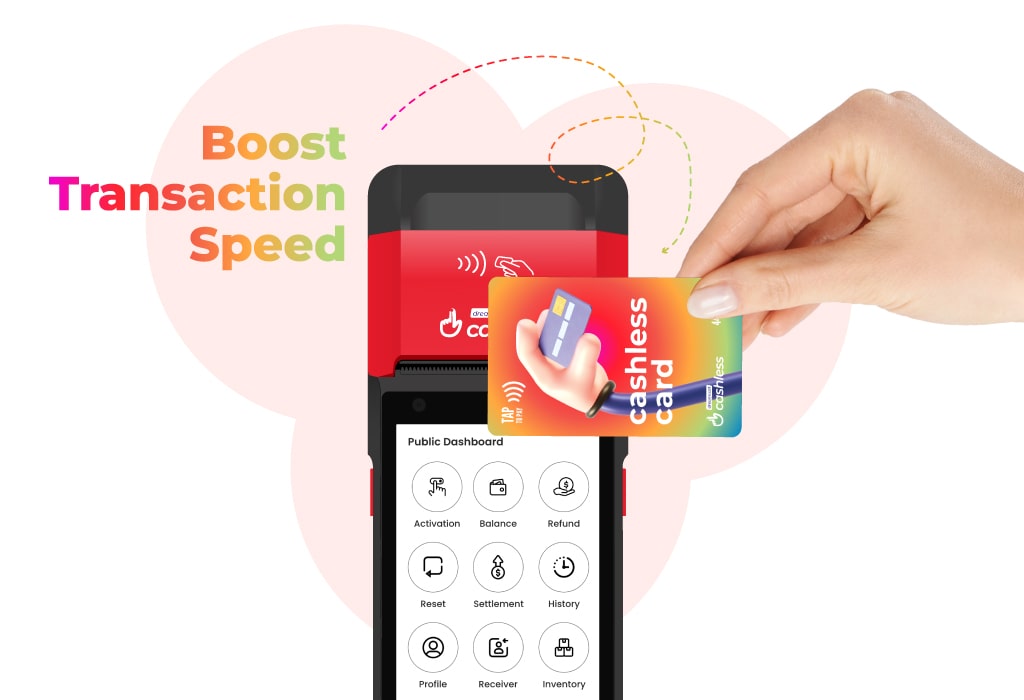
Dreamcast provides a cashless payment solution for music festivals and other event formats, supporting RFID/NFC credentials, centralized payment management, top-ups, vendor payments, transaction tracking, and reporting.
Its current event cashless platform also highlights offline payment capability, inventory management, recharge options, tax-compliant billing, and reporting.
For music-event organizers, the important question isn’t simply whether a provider offers cashless payments. It’s whether the platform can fit the complete operation, from attendee top-up and fast purchases to vendor management, inventory, reporting, refunds, and post-event reconciliation.
Conclusion
Cashless payment for music events is no longer just about replacing physical money with a tap.
For organizers, the real value comes from connecting the entire payment operation, from top-ups and purchases to inventory, vendor management, reporting, refunds, and reconciliation.
For attendees, the goal is simpler: less waiting and fewer payment hassles, so they can spend more time enjoying the music.
The right system should therefore be chosen around your event’s actual needs. A small concert may require a relatively simple setup, while a large multi-day festival needs scalable technology, multiple payment points, offline capability, strong reporting, and well-defined refund and support processes.
When the payment experience works smoothly in the background, attendees can focus on what they came for: the music.
FAQs
Cashless payment for music events offers attendees a hassle-free way to make purchases. With a simple tap or scan, attendees can quickly complete transactions using their smartphones, contactless cards, or wristbands. This eliminates the need to carry physical cash or search for an ATM, reducing waiting times and congestion at event venues.
Cashless payments at music events and festivals provide enhanced safety and security compared to traditional cash transactions. Physical cash carries risks of loss, or theft, which are mitigated by using digital payment methods. Additionally, cashless transactions offer improved traceability, making it easier to detect and prevent fraudulent activities.
Contactless Digital Payment Solutions offer event organizers valuable insights into attendees’ purchasing patterns, preferences, and behavior. By analyzing this data, organizers can make informed decisions regarding inventory management, pricing strategies, and resource allocation. These insights enable organizers to optimize their operations, enhance customer satisfaction, and tailor future events to better suit attendees’ preferences.
Cashless payment systems facilitate faster transactions, which can lead to increased sales for vendors and higher revenue for event organizers. Moreover, cashless systems provide real-time transaction data, helping organizers optimize inventory management and make informed business decisions.
Cashless payment allows attendees to purchase food, beverages, merchandise, and other products without using physical cash for every transaction. Depending on the system, they can use RFID/NFC wristbands or cards, QR codes, cards, or digital wallets.
Cashless payment offers advantages such as reduced wait times, shorter queues, enhanced accuracy, and minimized risk of theft or loss, as attendees don’t need to carry physical cash.
An RFID wristband can be linked to an attendee’s payment account or wallet. The attendee taps it at a supported payment terminal to complete a purchase, while the transaction is recorded digitally.
Yes. Cashless systems can be particularly useful for festivals with large crowds, multiple vendors, and high transaction volumes. The system should be selected and configured according to the festival’s expected scale and operational requirements.
Some cashless systems support offline transactions, allowing vendors to continue processing payments during temporary connectivity problems. Always confirm how offline transactions are stored and synchronized with your provider.
That depends on the organizer’s refund policy. If balances are refundable, attendees should be told how, when, and where to request their refunds before the event.
Evaluate payment speed, RFID/NFC/QR support, scalability, offline capability, top-ups, refunds, security, inventory and vendor management, reporting, integrations, technical support, and total cost.