

Video now sits at the center of how businesses reach, teach, and sell to audiences, and choosing between live and recorded delivery shapes both cost and results. This guide explains how live and on-demand streaming differ and how to choose between them.
TL;DR
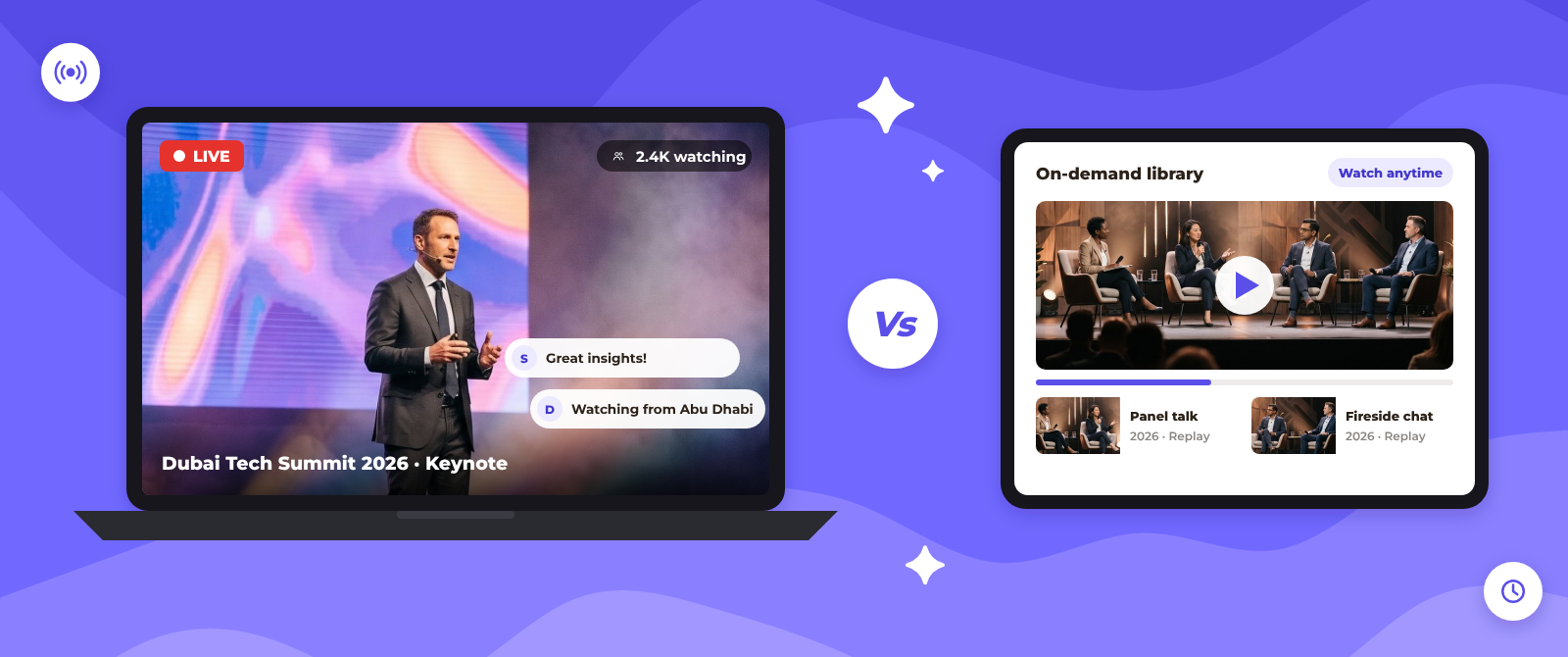
Live streaming delivers video to viewers in real time, as it is being captured. On-demand video streaming, often called video on demand (VOD), delivers pre-recorded content that viewers can watch whenever they like. Live streaming is the better fit for product launches, webinars, events, and any situation where real-time interaction matters. VOD is the better fit for training libraries, tutorials, marketing videos, and content you want people to find and watch long after publication.
The two formats are not rivals. Many businesses stream live, then save the recording as VOD to extend its value. The right choice depends on your goals, your audience, your budget, and the technical resources you have available.
What Is Live Streaming?
Live streaming is the transmission of video over the internet at the same moment it is recorded. There is no waiting for a file to be produced, edited, and uploaded. Viewers tune in as the action unfolds, and the experience is shared: everyone watching sees roughly the same thing at roughly the same time.
What makes live streaming distinctive is immediacy and interaction. Audiences can ask questions in a chat window, answer polls, send reactions, or even make purchases while the broadcast is underway. That sense of presence is difficult to replicate with pre-recorded video, and it is the main reason brands, educators, and creators rely on live formats to build engagement.
The market reflects that appeal. The global live streaming market increased from USD 108.7 billion in 2025 to USD 139.6 billion in 2026 and is projected to reach USD 687.2 billion by 2034, expanding at a CAGR of 22.05% during 2026–2034.
How Real-Time Video Broadcasting Works
Although the viewer experience feels simple, a live stream passes through several stages in a matter of seconds.
- Capture. A camera and microphone record the video and audio. This can be anything from a smartphone to a multi-camera production setup.
- Encoding. Software or hardware encoders compress the raw footage into a format suitable for the internet, typically using codecs such as H.264 or H.265.
- Ingest. The encoded stream is sent to a streaming server or platform using a protocol such as RTMP, SRT, or WebRTC.
- Transcoding and packaging. The server creates multiple versions of the stream at different resolutions and bitrates, then packages them for delivery using protocols like HLS or MPEG-DASH. This allows adaptive bitrate streaming, where the player automatically switches quality based on each viewer’s connection.
- Delivery. A content delivery network (CDN) distributes the stream to viewers around the world, reducing buffering and spreading the load across many servers.
- Playback. The viewer’s player decodes the video and displays it on their device.
Latency, the delay between the live action and what the viewer sees, is the defining technical challenge. Standard HLS streaming can run 10 to 30 seconds behind real time, while low-latency HLS and WebRTC can bring that down to a few seconds or even under a second. Interactive use cases such as auctions, live Q&A, and online gaming need the lowest latency available.
Common Use Cases for Live Streaming
Live streaming earns its place wherever timing and participation add value.
- Webinars and virtual events. Conferences, panel discussions, and product demos reach a global audience without travel costs.
- Product launches and announcements. A live reveal creates urgency and gives your team a chance to answer questions on the spot.
- Live commerce. Hosts demonstrate products and sell them in real time, which has become a major retail format in many markets.
- Sports and entertainment. Fans expect to watch games, concerts, and performances as they happen.
- Corporate communications. Town halls and all-hands meetings keep distributed teams aligned.
- Education and training. Live classes allow instructors to respond to students directly.
- Worship, community, and news broadcasts. Real-time coverage connects audiences to events they cannot attend in person.
The tradeoff is that live streaming leaves little room for error. There are no retakes, so reliable equipment, a stable network, and a rehearsed run of show are essential.
To see how event organizers are putting these formats to work, read Dreamcast’s guide to live streaming trends transforming events in 2026.
What Is On-Demand Video Streaming?
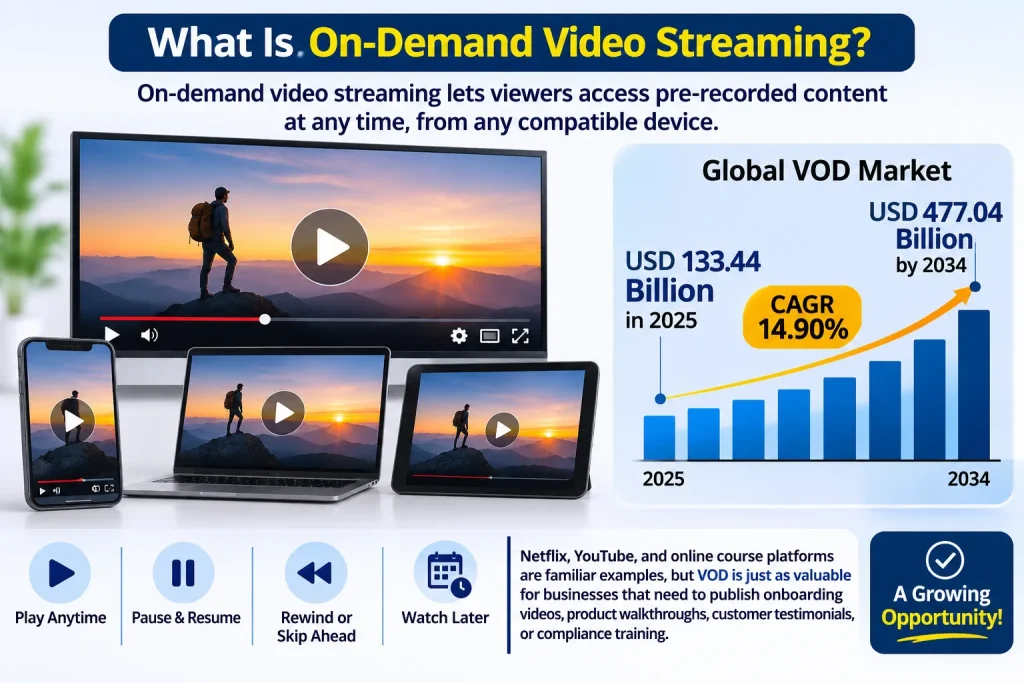
On-demand video streaming lets viewers access pre-recorded content at any time, from any compatible device. The video has already been shot, edited, and stored, so the viewer simply presses play. They can pause, rewind, skip ahead, or return to the same video days or months later.
Netflix, YouTube, and online course platforms are familiar examples, but VOD is just as valuable for businesses that need to publish onboarding videos, product walkthroughs, customer testimonials, or compliance training. Unlike a live event, a VOD asset keeps working for you long after it is published.
The category is also growing quickly. The global video-on-demand (VOD) market is valued at USD 133.44 billion in 2025 and is projected to reach USD 477.04 billion by 2034, a compound annual growth rate (CAGR) of 14.90%, according to the Fortune Business Insights Video on Demand Report.
How VOD Platforms Work
A VOD platform follows a different workflow from a live stream because the content exists as a finished file before any viewer sees it.
- Upload. The source video file is uploaded to the platform or to cloud storage.
- Processing and transcoding. The platform converts the file into multiple resolutions and bitrates so it plays smoothly on phones, tablets, laptops, and smart TVs.
- Storage and organization. Files are stored along with metadata such as titles, descriptions, tags, thumbnails, and captions, which makes the library searchable.
- Protection and access control. Options such as password protection, domain restrictions, geo-blocking, and digital rights management (DRM) keep premium or private content secure.
- Delivery. A CDN serves the video to viewers, using adaptive bitrate streaming to match playback quality to each connection.
- Analytics. The platform tracks views, watch time, drop-off points, and engagement so you can see what is working.
Because nothing needs to be delivered instantly, VOD can use more aggressive buffering and caching. The result is typically more stable playback and higher visual quality than a live stream of similar scale.
For a deeper look at the basics, see Dreamcast’s explainer on VOD streaming: definition and how it works.
Benefits of Recorded Video Content
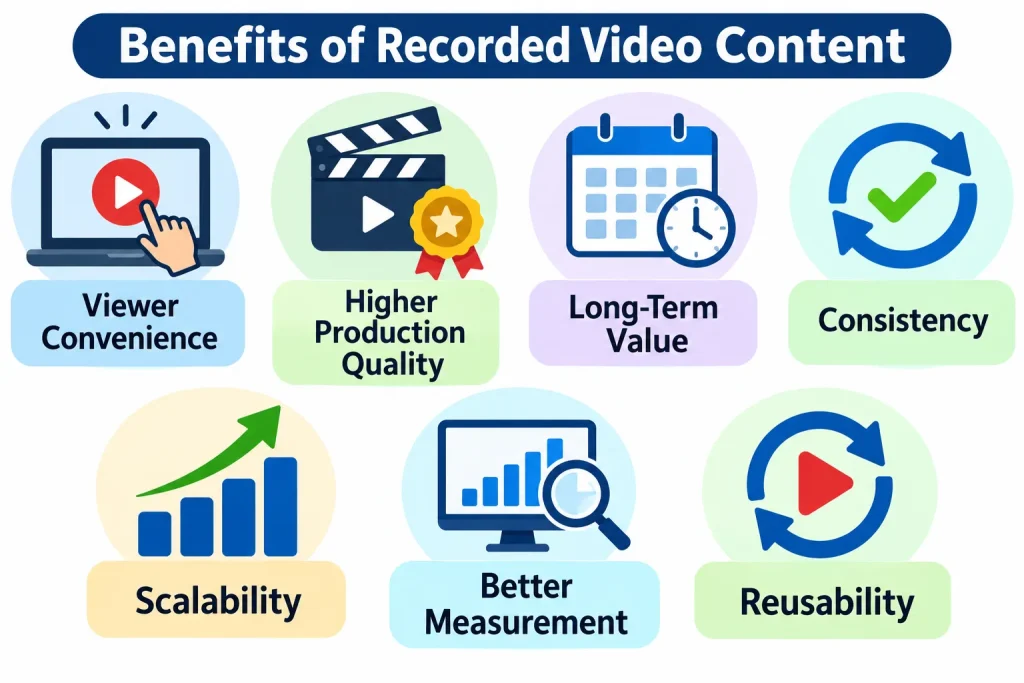
Recorded video offers several advantages that make it the backbone of most content strategies.
- Viewer convenience. People watch when it suits them, across time zones and schedules, which tends to raise total reach.
- Higher production quality. Editing, color correction, graphics, and sound design are all possible before publishing.
- Long-term value. A single video can attract views for years, particularly when it is optimized for search.
- Consistency. You control the message precisely, with no risk of a technical failure or an off-script moment in front of a live audience.
- Scalability. Once uploaded, a video can serve one viewer or a million without additional effort from your team.
- Better measurement. Detailed analytics reveal where viewers lose interest, helping you refine future content.
- Reusability. Clips, highlights, and snippets can be repurposed for social media, email, and sales enablement.
The main limitation is the lack of real-time connection. Viewers can comment or reach out afterward, but the immediate energy of a live audience is absent.
Which Streaming Solution Is Right for Your Business?
The best approach starts with your objective rather than the technology. Ask what you want viewers to do, how quickly, and whether they need to interact with you while they watch.
Choose live streaming when:
- Real-time interaction is central to the experience, such as Q&A, polls, or live selling.
- The event is time-sensitive, such as a launch, announcement, or breaking update.
- You want to build community and a sense of occasion around a moment.
- Your team can support the added production and technical demands.
Choose on-demand streaming when:
- Your content is educational, evergreen, or reference material that people will revisit.
- Polish and consistency matter more than immediacy.
- Your audience spans many time zones and cannot gather at one time.
- You want to build a searchable library that supports marketing, training, or customer support over the long term.
Consider combining both when:
- You can record every live session and publish it as VOD afterward, giving people who missed it a way to catch up.
- You want to cut long live broadcasts into short highlights for social channels.
- A hybrid program is the goal, such as a live launch event backed by a library of on-demand tutorials.
| Factor | Live Streaming | On-Demand Streaming |
| Timing | Real-time, scheduled | Anytime, viewer’s choice |
| Interaction | Immediate (chat, polls, Q&A) | Delayed (comments, follow-up) |
| Production | Limited room for error | Fully editable before release |
| Lifespan | Short, unless recorded | Long-term, searchable |
| Technical demands | Low latency, stable upload | Storage and library management |
| Best for | Events, launches, live commerce | Training, tutorials, marketing |
Budget and infrastructure matter too. Live streaming demands a reliable upstream connection, backup plans, and often a producer or technical operator. VOD requires storage, encoding, and content management, but the workload is spread out over time rather than concentrated into a single high-pressure moment. Whichever you choose, look for a platform that offers adaptive bitrate streaming, CDN delivery, security controls, analytics, and the ability to handle both formats as your needs evolve.
Conclusion
Live streaming and on-demand video solve different problems. Live streaming gives you immediacy, interaction, and a sense of occasion, while VOD gives you polish, convenience, and content that keeps working long after it is published. Neither is better in every case, and both markets are growing.
The strongest strategy usually combines the two: go live when real-time engagement matters, then record the session and publish it as on-demand content. Start with your audience and your goal, pick the format that serves them, and choose a platform that can grow with both.
FAQ
Ans: Live streaming broadcasts video as it happens, so viewers watch in real time. VOD delivers pre-recorded content that viewers can start, pause, and replay whenever they choose.
Ans: Yes. Most streaming platforms can record a live broadcast automatically and store it as a VOD file. You can publish it as is or trim and edit it first, which makes it easy to extend the life of an event.
Ans: It depends on the scale. A simple live stream can be inexpensive to run, but professional live events require more equipment, staff, and bandwidth at one time. VOD spreads costs across production, editing, and storage, and a single video can keep delivering value for years.
Ans: Latency is the delay between an event happening and viewers seeing it. It matters most for interactive experiences, such as live auctions or Q&A, where a long delay makes real-time conversation awkward. For passive viewing, a delay of several seconds is usually fine.
Ans: You need an encoder, which can be software such as OBS or a hardware device, plus a streaming platform or server to receive and distribute the video. Many platforms also let you go live directly from a browser or phone.