


TL;DR Pointers
- Event turnstile security and turnstile access control for events give organizers a controlled way to validate attendees and manage entry at busy venues.
- A typical event access control system connects a physical turnstile with QR codes, RFID/NFC credentials, ticketing, registration, access-control software, and real-time attendance data.
- Turnstiles can improve event access management, reduce manual validation, help prevent unauthorized access, provide useful crowd-flow data, and support zone-based access.
- However, the right system must be sized around peak arrival periods, not just total attendance, and should include accessible entry routes, emergency procedures, offline or backup plans, trained staff, and sufficient entry capacity.
- For large events, turnstiles work best as one part of a wider crowd-management and security strategy.
Introduction
Turnstile access control for events can create a controlled physical entry point where an attendee must present a valid credential before being allowed through. That credential could be a QR code, RFID wristband, access card, NFC credential, biometric identity, or another approved method.
Do you know that UEFA’s Stadium Infrastructure Regulations state that Category 3 and 4 stadiums must have at least one turnstile for every 660 spectators? Well, you do now.
When hundreds or thousands of people arrive at an event at the same time, the entrance can quickly become one of the hardest areas to manage.
You need to answer a simple question for every person trying to enter: Are they authorized to be here?
Traditional staff-led ticket checks can work for smaller gatherings, but larger events often need something faster and more controlled. This is where event turnstile security and access control can help.
Turnstiles are more than a way to stop unauthorized entry. When connected to event registration, ticketing, access rules, scanners, and real-time reporting, they can help organizers manage entry, capacity, different attendee categories, restricted zones, and crowd flow.
So, how do turnstiles work, what types are available, and when should an event organizer consider using one? Let us discuss it further.
What Is Turnstile Security and Access Control?
Turnstile access control for events is a physical entrance-control device that allows people to pass through one at a time after authorization.
Unlike an open entrance where staff manually decide whether someone can enter, a turnstile can automatically validate a credential and either allow or deny passage.
The physical equipment can range from tripod and waist-high turnstiles to full-height systems and optical or speed gates. The appropriate design depends on the event turnstile security level, environment, expected traffic, and whether the entrance needs to support emergency or accessible passage.
For an event, the basic setup usually includes:
- A turnstile or controlled entry lane
- A ticket, badge, wristband, card, or other credential
- A reader or authentication device
- Access-control software
- A database containing attendee permissions
- A monitoring or reporting system
- Staff to manage exceptions and assist attendees
The important point is that the turnstile itself is only one part of the access-control system. This is why the UK’s Health and Safety Executive’s Event Safety Guide states that the standard for sports stadia is based on a maximum notional flow rate of 660 people through a turnstile in one hour, or the measured flow rate if lower.
How Does Turnstile Access Control Work?
A 2026 peer-reviewed study using actual turnstile access records from San Mamés Stadium found a measured throughput of approximately 15 individuals per minute, equivalent to an average inter-arrival time of about 4 seconds per person.
The process is relatively straightforward for an attendee.
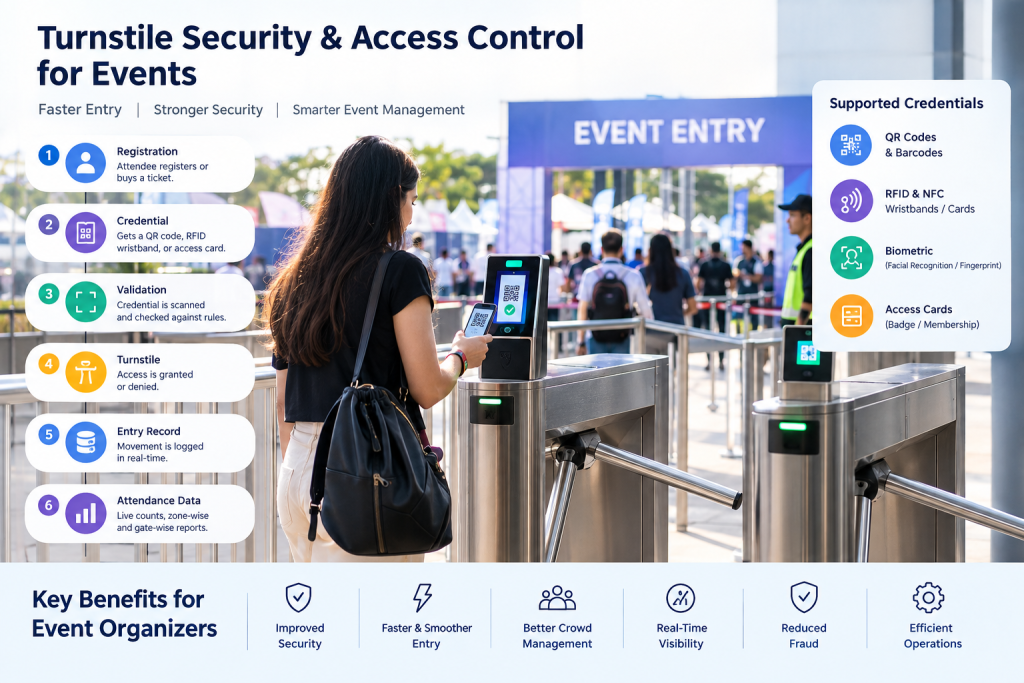
1) Attendee Receives an Event Access Credential
Before arriving, the attendee may register or purchase a ticket. They are then assigned a credential such as a QR code, RFID wristband, NFC card, or event badge.
That credential is connected to their event permissions.
2) The attendee presents the credential
At the entrance, the attendee scans or taps their credential at the turnstile.
The reader captures the credential and sends the information to the access-control system.
3) The system checks access permissions
The system checks whether the credential is:
- Valid
- Active
- Being used at the correct location
- Authorized for that particular date or time
- Permitted to enter the relevant zone
- Already used, where repeat entry is restricted
4) The turnstile allows or denies passage
If the credential meets the access rules, the mechanism unlocks or opens.
If it is invalid, expired, already used, or not authorized for that area, access is denied, and the attendee can be directed to an assistance desk.
5) The system records the movement
The access event can be logged, giving organizers information about who entered, when they entered, and where the entry occurred.
Modern RFID event access-control systems can also provide live entry counts and zone-level attendance information.
This creates a useful chain:
Registration → Credential → Validation → Turnstile → Entry Record → Real-Time Attendance Data
Types of Turnstile Access Control for Events
EY’s report on India’s live-events industry identified more than 70 concert days in 2024 where attendance exceeded 10,000 people per day.
But not every event needs the same type of turnstile. Your choice should depend on the venue, crowd, security requirements, and desired attendee experience.
Tripod Turnstiles
Tripod turnstiles use rotating arms and are commonly used where controlled pedestrian access is required.
They can work well for supervised event entrances, sports facilities, and other locations where organizers want a relatively compact access-control solution. Modern tripod systems can integrate with common identification readers and support multiple-lane installations.
Best suited for: controlled entrances, sports facilities, exhibitions, and lower-to-medium security applications.
Learn more about tripod turnstile access management for events.
Waist-High or Half-Height Turnstiles
These provide a more open entrance design while still controlling individual passage.
They are often appropriate for indoor venues, VIP areas, corporate spaces, and entrances where aesthetics matter alongside turnstile access control for events. Half-height systems can also be paired with swing doors to provide accessible passage.
Best suited for: conferences, corporate events, VIP areas, and indoor venues.
Full-Height Turnstiles
Full-height turnstiles provide a stronger physical barrier because they extend from the floor to above the user’s height.
They are particularly useful where preventing people from climbing over or bypassing the entrance is a higher priority. They can also be designed for outdoor use and can incorporate emergency-exit and accessible-gate options.
Best suited for: stadiums, large outdoor events, restricted areas, and high-security environments.
Optical or Speed Gates
Optical systems use sensors and moving barriers rather than traditional rotating arms. They can provide a more open, modern appearance while controlling individual passage.
These systems are useful when organizers want to balance security, visitor experience, aesthetics, and people flow.
Best suited for: premium venues, conferences, corporate events, and modern indoor facilities.
Portable or Temporary Turnstiles
Events do not always take place in permanent venues. Festivals, exhibitions, sports events, and temporary installations may require access equipment that can be deployed and removed as needed.
In these situations, organizers should look for systems designed for temporary installation, suitable weather protection, easy configuration, and integration with the event’s credential system.
What Technologies Can Be Integrated With Event Turnstile Access Control?
Did you know that EY-Parthenon reported that India’s organized live entertainment segment surpassed ₹12,000 crore in 2024 and projected approximately 19% CAGR over the following three years?
A turnstile becomes significantly more useful when connected to the technology already being used to manage your event.
QR Codes and Barcodes
QR and barcode readers can validate digital or printed tickets at the entrance.
This can work well for conferences, exhibitions, ticketed experiences, and other events where attendees already receive digital tickets.
RFID and NFC
RFID wristbands, badges, and cards can be tapped at compatible readers.
This is particularly useful for festivals and multi-zone events because the same credential can potentially be used for entry, access permissions, and other event functions.
Biometric Authentication
Some access-control systems can integrate biometric technologies such as facial recognition or fingerprint authentication.
This can be appropriate for highly controlled environments, but organizers should consider privacy, consent, local regulations, fallback procedures, and accessibility before using biometrics.
Event Ticketing and Registration Systems
Integration with registration or ticketing software allows access permissions to be based on the attendee’s actual registration. For example:
VIP ticket → VIP access
Speaker credential → Speaker areas
Exhibitor badge → Exhibition and exhibitor areas
General admission → Public areas only
This eliminates the need for staff to manually interpret every credential.
CCTV and Security Systems
Turnstiles can also operate alongside CCTV and security monitoring. The access record can provide useful context for security teams investigating incidents or monitoring crowd movement.
What Are the Benefits of Turnstile Access Control for Events?
EY-Parthenon and BookMyShow’s analysis found that more than 222,000 fans attended Coldplay’s two-night Music of the Spheres concerts in Ahmedabad.
So, once turnstiles are connected to an appropriate access-control system, they can provide several operational benefits in such huge music concerts.
Faster and More Controlled Entry
Automated validation reduces the need for staff to manually inspect every ticket or badge.
This can help create a more consistent entrance process, particularly during peak arrival periods.
A 2026 study using real turnstile access records from UEFA Europa League matches at San Mamés Stadium found that access protocols and crowd-flow management could materially affect density and movement around stadium entrances.
Better Access Security
A credential-based system can prevent unauthorized people from simply walking through an open entrance.
It can also help identify duplicate, invalid, expired, or unauthorized credentials.
RFID access-control systems can additionally support pass-back detection and zone-level permissions.
Real-Time Attendance Visibility
Instead of estimating how many people have entered, organizers can use access records to monitor entry counts.
This can help teams understand:
- Arrival patterns
- Peak entry periods
- Gate performance
- Zone occupancy
- Re-entry activity
- Overall attendance
Better Crowd Management
If one entrance is becoming congested while another is underused, real-time information can help event teams respond.
For large venues, this can be especially important because crowd safety is not just about controlling access. It is also about managing how people move around the venue.
Reduced Fraud
A unique credential connected to an attendee record makes it more difficult to reuse or duplicate access credentials.
This is particularly useful for VIP, staff, media, backstage, hospitality, and other restricted areas.
Better Data for Post-Event Planning
Access records can show organizers what happened at the entrance rather than relying entirely on assumptions.
You can compare actual arrival patterns with staffing, gate capacity, programming schedules, and venue layouts when planning the next event.
Where Are Turnstile Access Control Systems Used?
The International Association of Professional Congress Organisers reported that its accredited PCO members organized 23,512 meetings and events worldwide in 2025, representing a 20.77% increase from 2024.
Turnstiles are useful wherever an organizer needs controlled movement through a defined entrance. Some of the common applications include:
Festivals and Concerts
Large festivals often have multiple gates, attendee categories, restricted backstage areas, and high arrival volumes.
RFID turnstile access control for events can be particularly useful when attendees use wristbands across the event.
Sports Events and Stadiums
Stadiums are a natural use case because organizers need to manage large crowds entering defined gates and seating zones.
Research has used actual stadium turnstile data to model fan arrival patterns and crowd density, demonstrating how turnstile data can also support crowd-flow analysis.
Conferences and Exhibitions
Turnstiles can be used to control entry to the main event and restricted areas such as VIP lounges, speaker rooms, exhibitor zones, or workshops.
Corporate Events
For invite-only events, turnstiles can provide a more controlled alternative to an open entrance while integrating with badges or digital credentials.
Theme Parks and Attractions
Controlled entry points can validate tickets and help manage visitor movement into different attractions or zones.
How Are Turnstiles Used for Event Turnstile Security?
Turnstiles should be viewed as one layer of an event security strategy, not the entire strategy.
A strong setup might combine:
Ticketing/registration → credential issuance → turnstile validation → security screening → CCTV → zone access → emergency procedures
For example, a festival attendee might register online and receive an RFID wristband. At the entrance, the wristband is validated by the access-control system. If valid, the turnstile permits entry and records the movement.
A VIP attendee may have additional permissions, allowing the same credential to provide access to a VIP lounge or hospitality zone.
Meanwhile, security teams can monitor entry activity and investigate exceptions.
The system should also have a contingency plan. FIFA’s stadium guidance specifically identifies failures involving turnstiles, spectator-entry counting systems, and automated turnstile mechanisms as scenarios that should be addressed in contingency planning.
Turnstiles vs Traditional Event Check-In
The difference becomes clearer when you compare the two approaches.
| Factor | Traditional Check-In | Turnstile Access Control |
| Validation | Usually staff-led | Automated |
| Physical access control | Limited | Stronger |
| Entry records | May require manual scanning | Automatically logged |
| Staffing | More staff may be needed | Staff mainly handle exceptions |
| Zone control | Often manual | Can be automated |
| Capacity monitoring | May be estimated | Can use entry/exit data |
| Fraud prevention | Depends on staff/process | Credential-based validation |
| Peak arrival handling | Can create queues | Multiple lanes can automate entry |
| Best suited for | Smaller or simpler events | Controlled, high-volume events |
That does not mean turnstiles should replace staff.
But you must address that the Association of International Convention Centres’ 2025 Member Survey reported that member venues experienced an average 9.2% increase worldwide and a 10.3% increase in Asia in total event attendance in 2024 compared with 2023. You need to be prepared for this crowd when it is your turn.
For most events, staff are still important for troubleshooting, accessibility assistance, lost credentials, guest questions, security escalation, and emergencies.
The difference is that staff no longer have to perform every routine validation manually.
Turnstile Access Control vs Door Access Control
Turnstiles and door-based access control solve related but different problems.
A door access-control system typically controls access through a single doorway using a lock, reader, credential, or biometric system.
A turnstile is specifically designed to manage individual pedestrian flow through an entrance.
What to Consider When Choosing a System for Event Turnstile Security?
Do not start by asking, “Which turnstile should we buy?”
Start with your event requirements.
1. Expected Attendance and Peak Arrival
Calculate how many people may arrive during your busiest 15-, 30-, or 60-minute period.
A turnstile setup should be designed around peak demand, not average attendance.
2. Required Security Level
A conference may need simple credential validation, while a stadium or restricted outdoor event may require stronger physical barriers.
3. Credential Technology
Decide whether your event will use QR codes, RFID, NFC, biometrics, cards, or a combination.
4. Integration
Check whether the turnstile integrates with your registration, ticketing, access-control, security, and reporting systems.
5. Emergency and Power-Failure Behavior
You must ask exactly what happens when:
- Power fails
- The network goes down
- A fire alarm is triggered
- A turnstile malfunctions
- An attendee needs emergency exit access
Turnstile specifications should include appropriate safety and emergency arrangements; some modern systems offer configurable behavior during power failures and dedicated escape-route options.
6. Accessibility
Do not design an entrance that works only for the average attendee.
Provide appropriate accessible routes and make sure they are integrated into the overall access-control plan.
7. Weather and Venue Conditions
Outdoor festivals may require weather-resistant equipment, while indoor conferences may prioritize aesthetics and compact installation.
8. Support and Onsite Staffing
Even an automated system needs people behind it.
Ask about installation, testing, onsite technical support, replacement equipment, troubleshooting, and emergency escalation.
Also Read: How Turnstile Access Management Transforms Events in Saudi Arabia
Common Event Turnstile Security Challenges
Turnstiles can solve many problems, but they can also create new ones if poorly planned.
Queues at Peak Times
A turnstile does not automatically eliminate queues.
If you have too few lanes, slow readers, poor signage, or a complicated validation process, queues can still form.
Credential Problems
Attendees may arrive with:
- Damaged wristbands
- Dead phones
- Invalid QR codes
- Incorrect credentials
- Duplicate tickets
- Credentials assigned to someone else
You need an exception-handling process.
Network or Power Failures
Your system should have a clearly tested offline or backup mode where appropriate.
Accessibility and Emergency Egress
Every entrance plan must account for accessible passage and emergency evacuation. Event turnstile security should never create a situation where people cannot exit safely.
Poor Integration
A technically excellent turnstile can still become a problem if it does not communicate properly with your registration or ticketing system.
Before the event, test the complete journey, not just the hardware.
Are Turnstiles Suitable for Large Events?
Yes, provided they are properly designed and deployed.
Turnstile access control for events can be particularly valuable for large festivals, stadium events, exhibitions, conferences, and other gatherings where organizers need controlled entry, multiple access points, credential validation, and real-time attendance information.
Modern event access platforms can scale RFID access across numerous gates and lanes while providing live entry counts and zone-level information.
Read more about: Turnstile Entry with QR Code Check-In: A Smarter Way to Manage Events
But scale should never be measured only by the total number of attendees.
The more important question is:
How many people need to enter, through how many gates, within what period?
A 50,000-person event with attendees arriving gradually may be easier to manage than a 10,000-person event where most guests arrive within 20 minutes.
So, size your turnstile infrastructure around peak arrival patterns, gate capacity, credential type, venue layout, and emergency requirements.

FAQs
Yes, when integrated with appropriate credentials, access-control rules, monitoring, and security procedures. The turnstile provides the physical barrier, while the connected system determines whether a person is authorized to enter.
Yes, compatible turnstile systems can integrate with QR or barcode readers. The exact capability depends on the hardware and access-control platform you choose.
Yes. RFID readers can validate wristbands and connect the credential to attendee permissions. This is particularly useful for festivals and multi-zone events.
They can reduce manual validation time and improve entry flow, but they do not automatically eliminate queues. You still need enough lanes, fast readers, clear signage, and an efficient exception-handling process.
Yes. Integrated access-control systems can record entry events and provide real-time counts. More advanced systems can also report activity by gate, time, or access zone.