



TL;DR
Event registration in 2026 is becoming more flexible, connected, and data-driven. Late registrations, high-volume check-in, data integration, personalization, accessibility, privacy, and AI are reshaping how organizers manage the attendee journey. For organizers tracking event registration trends in Dubai, these shifts are especially relevant as large-scale and international events continue to grow.
Introduction
Getting people to register for an event is easy. Getting registration to work smoothly when plans change is where the real challenge begins.
Attendees may register at the last minute, update their details, switch sessions, arrive in large numbers, or need assistance at the venue. At the same time, event teams need that registration data to support check-in, badges, access, communication, and reporting.
This is becoming especially important in Dubai, where events can bring together large and international audiences.Dubai World Trade Centre’s official 2025 results report 401 events hosted at DWTC venues in 2025, with nearly 3 million participants.
As registration becomes more connected to the wider event experience, organizers need more than a form that collects names. They need a process that can adapt to changing attendee needs, handle operational pressure, and keep registration moving from sign-up to arrival.
So, what are the key event registration trends and challenges in 2026, and how can organizers prepare for them?
Notable Event Registration Trends and Challenges in 2026

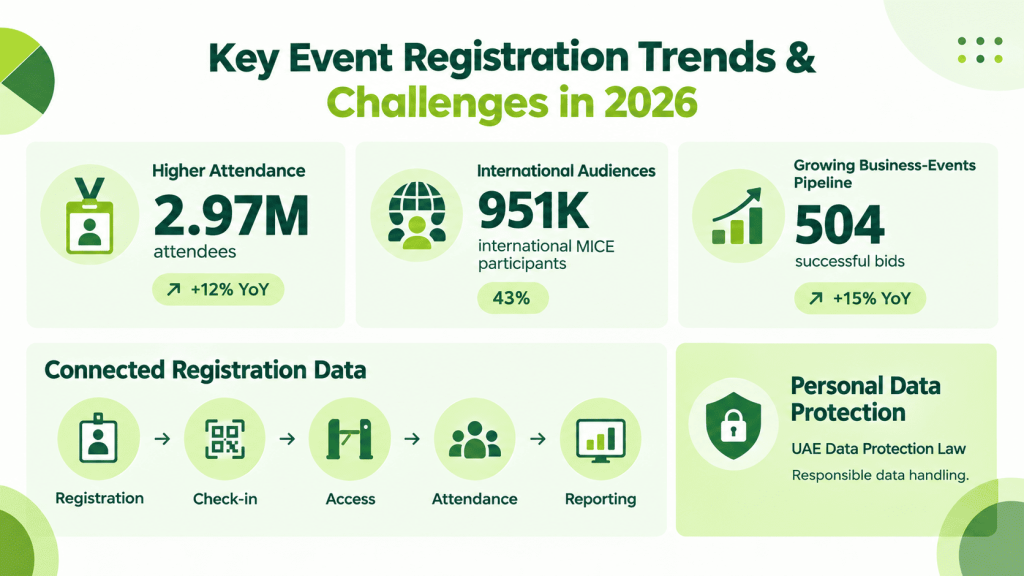
Dubai’s event ecosystem is expanding in both volume and participation. DWTC reported 401 events in 2025, attracting 2.97 million attendees, a 12% increase in attendance year over year. Its MICE portfolio alone included 134 events and 2.19 million participants, with international attendees accounting for approximately 43% of MICE participation.
That scale gives organizers a useful indication of why registration processes need to handle volume, international audiences, different attendee categories, and efficient onsite movement.
1. Higher Attendance Means Greater Registration Pressure
DWTC’s 2.97 million attendees in 2025 represented 12% year-on-year growth, while its 401-event calendar grew by 6%.
For registration teams, growth in attendance can translate into greater pressure around check-in capacity, attendee verification, credential issuance, and peak arrival periods.
The challenge is therefore not simply accepting more registrations. It is ensuring that the registration-to-arrival process can maintain its performance as attendee volume increases.
2. International Audiences Require More Flexible Registration Journeys
International participation is another important consideration. DWTC reported approximately 951,000 international participants across its MICE events in 2025, representing 43% of total MICE attendance.
This makes registration more than a simple name-and-email collection exercise. Organizers may need to account for different attendee categories, communication requirements, session selections, and onsite assistance needs.
A registration process designed around a single, identical attendee journey may therefore create unnecessary friction.
3. The Business-Events Pipeline Is Continuing to Grow
Dubai Business Events secured 504 successful bids in 2025, a 15% increase from 2024. These wins are expected to attract 272,262 delegates to Dubai through 2029. Dubai also hosted 481 DBE-supported business events in 2025, compared with 429 in 2024—a 9% increase.
For registration teams, this continued pipeline reinforces the need for processes that can scale across conferences, exhibitions, association meetings, and other business events rather than relying on one fixed registration model.
4. Registration Data Must Remain Accurate Across the Attendee Journey
As registration connects with communication, check-in, attendance, credentials, and reporting, inaccurate or outdated attendee information can create problems beyond the registration form itself.
This becomes particularly important for large and international events, where even a small data-management issue can affect multiple downstream processes.
The trend in 2026 is therefore toward more usable and connected attendee information, rather than simply collecting larger amounts of data.
5. Accessibility Is Becoming Part of Digital Registration
The W3C Web Content Accessibility Guidelines (WCAG) 2.2 include requirements around labels and instructions, error identification, error suggestions, and error prevention for user input.
For event registration, that means forms should make it clear what attendees need to enter, identify errors in understandable language, and help users correct mistakes.
6. Personal Data Protection Cannot Be an Afterthought
The UAE’s Federal Decree-Law No. 45 of 2021 Regarding the Protection of Personal Data establishes a framework covering personal-data processing, privacy, confidentiality, security, and related requirements.
For organizers, registration planning therefore needs to consider not only what information is collected, but also why it is collected, who can access it, where it is stored, and how it is handled throughout the event lifecycle.
How to Address Event Registration Challenges in 2026
Addressing registration challenges does not always require a complicated setup. A few practical changes can make registration easier for both attendees and event teams.
- Make Registration Easy to Manage: Collect only the information you need and avoid unnecessary fields, especially as attendee numbers grow.
- Keep the Process Flexible: Allow attendees to update details, change sessions, register later, or request different access when needed.
- Make Registration Easy to Complete: Use clear questions, simple instructions, and helpful error messages to reduce confusion.
- Make Registration Data Useful Beyond Sign-Up: Connect registration information with communication, check-in, badges, access, attendance, and reporting where appropriate.
- Prepare for Unexpected Situations: Have a simple process for onsite registration, detail changes, late arrivals, and attendee assistance.
- Handle Attendee Information Responsibly: Collect only necessary information and ensure it is accessed and handled appropriately.
A practical registration process does not need to be complicated. It needs to be simple for attendees, flexible when plans change, and manageable for the event team.

What’s Next for Event Registration?
As events become larger, more international, and more varied, registration will need to keep adapting to the way people attend and interact with events. The focus is likely to move further toward registration processes that are easier to use, flexible enough to handle changes, and connected to what happens after sign-up.
For organizers, this means asking practical questions: Can attendees complete registration without unnecessary steps? Can their information be updated when plans change? Can the same information support check-in and other parts of the event? And can the process remain simple while handling privacy and accessibility requirements?
For Event Registration in Dubai, these considerations are particularly relevant as organizers manage events with different audience groups and large numbers of participants. The next stage of registration will therefore be less about adding complexity and more about making the entire journey work smoothly.
Frequently Asked Questions
Common challenges include managing higher attendee volumes, handling different attendee requirements, keeping registration data accurate, making forms accessible, and protecting personal information. The right approach depends on the event size, audience, and operational requirements.
Keep forms simple, ask only for necessary information, provide clear instructions, and make it easy to correct mistakes or update details. A straightforward registration process can reduce confusion and improve the attendee experience.
Registration data can support several parts of an event, including attendee communication, check-in, badge printing, access management, attendance tracking, and reporting. Keeping this information accurate and useful can also reduce repeated work for event teams.
Organizers should consider expected attendance, different attendee groups, international audiences, onsite requirements, accessibility, and responsible handling of personal information. The registration process should also be flexible enough to accommodate changes before and during the event.